Getty Museum
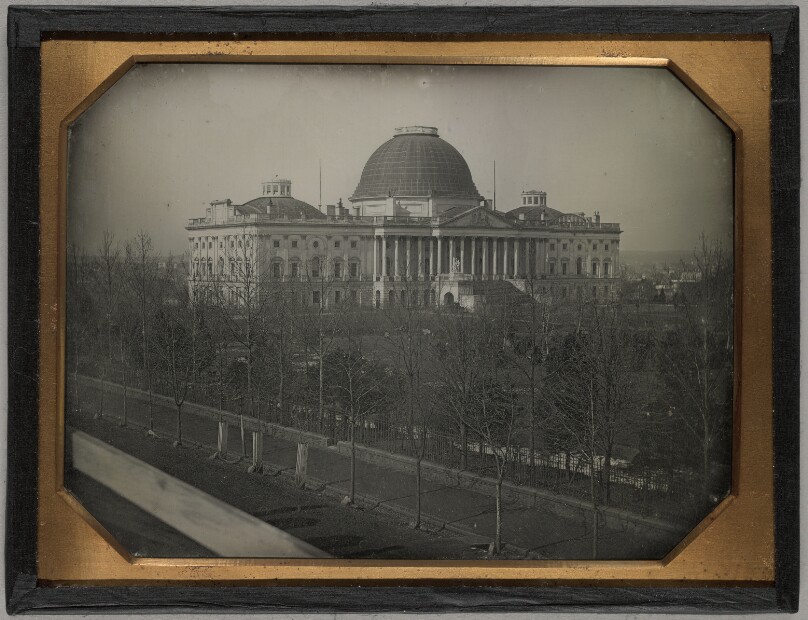
The United States Capitol
Creator
John Plumbe, Jr.American Daguerreotypist · 1809–1857
All works by this person →Short on funds and waiting to receive a commission from the United States Congress to survey the route for a transcontinental railroad, an idea which he is credited with originating, civil engineer John Plumbe, Jr., took up photography in 1840 after seeing the work of an itinerant daguerreotypist in Washington, D.C. A Welshman by birth, Plumbe opened a gallery in Boston the following year. He even
More on Getty ULAN- Date
- 1846
- Medium
- Daguerreotype
- Culture
- American
- Department
- Photographs
- Institution
- Getty Museum
- Object ID
- 883ea903-42df-471d-910d-c8ed9e3f0fa7
From the Getty Museum record
"Mr. Plumbe's National Daguerrian Gallery at Concert Hall...an establishment whose superior merits are well deserving the notice of all who feel an interest in the beautiful art of Photography...is now engaged in taking views of all the public buildings," read the *United States Journal* newspaper in January 1846. By February, another Washington, D.C. paper noted that "Views of the Capitol...embellish the walls [of John Plumbe's gallery] and are the subject of universal commendation." Plumbe's three views of the United States Capitol form its first photographic record. Here it is shown in an oblique view of the east front, with the White House visible in the far distance at the right. The Capitol, whose original building was begun in 1791 and took thirty-four years to construct, stands at the intersection of Pennsylvania, Constitution, and Independence Avenues. When Plumbe photographed it in the 1840s, before extensive expansions had begun, it was a relatively simple building but one that had already been altered by at least four architects. The early wings that then housed the House of Representatives and the Senate presently serve to connect the chambers with the central rotunda.
The authoritative record is held by Getty Museum. LinkedCulture surfaces this object and its connections; it does not alter institutional metadata.
Get printable QR codesHide QR codes
Open QR codes for this object page and the museum record. They stay collapsed until needed.
Related across collections
Semantically similar works from Getty Museum and other institutions.