Getty Museum
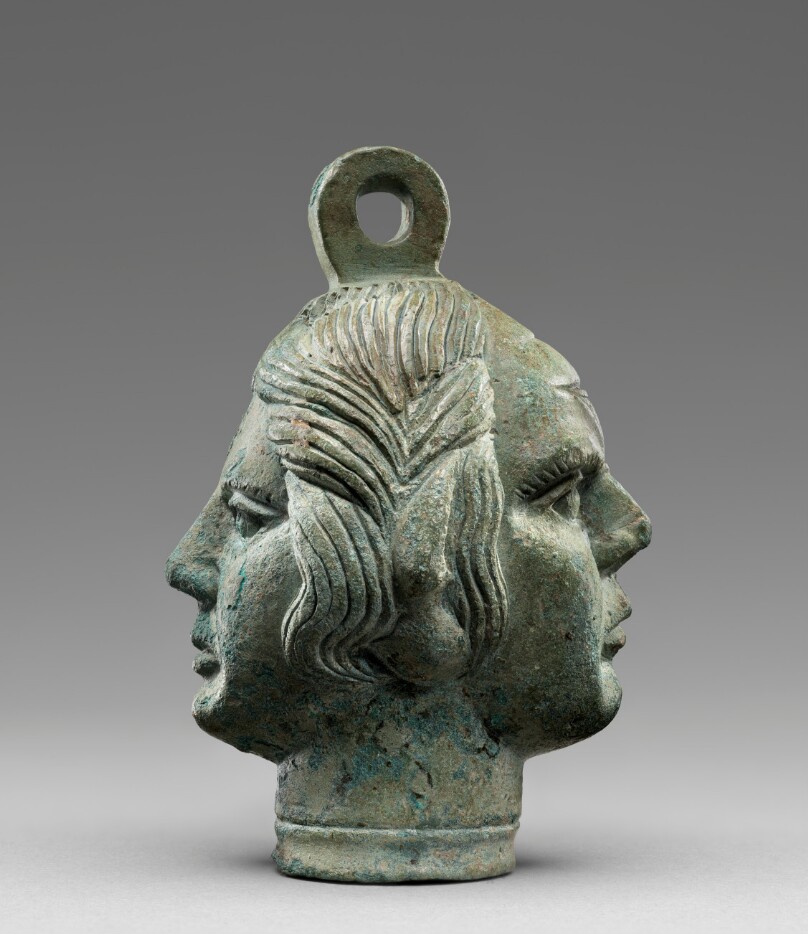
Weight with Heads of a Maenad and a Satyr
Creator
UnknownAll works by this person →More on Getty ULAN- Date
- 300–100 B.C.
- Medium
- Bronze with lead fill
- Culture
- Etruscan
- Department
- Implements
- Institution
- Getty Museum
- Object ID
- 8931580a-1315-41f8-87f2-0c49c33fc119
From the Getty Museum record
A double herm of a satyr and maenad is formed of two half-heads joined back-to-back on a single neck, at the base of which is a shallow cavetto molding. The male head has asymmetrical features, with one eye set lower than the other, a deeply creased forehead, and a receding hairline. A pair of pointed ears emerge from between coarsely grooved locks of hair, identifying the figure as a satyr, a follower of Dionysos. His female companion has more regular features; at the center of the forehead is a short fringe of hair that falls in soft waves to either side of the face. Both faces have incised pupils and vertical incisions along the brow ridge. The double herm was hollow cast in bronze and filled with lead, and is fitted with a suspension loop at the top, indicating that it served as an aequipondium, or counterweight for a steelyard scale. Similar to mechanical scales still in use, the instrument consisted of a tray for objects hanging from one end of a calibrated beam, along which differently sized weights on hooks slid until the arm balanced. Like the later weights found in great quantities at Pompeii and other Roman sites, Etruscan weights were carved of stone or cast in metal in the form of animals, human heads and busts, or mythological figures, as well as plain spherical and pyramidal shapes. Closely comparable to this counterweight are a pair of hanging weights (two maenads, satyr and maenad) from the Fucoli sanctuary near Chianciano Terme, dating to the fourth century B.C.
The authoritative record is held by Getty Museum. LinkedCulture surfaces this object and its connections; it does not alter institutional metadata.
Get printable QR codesHide QR codes
Open QR codes for this object page and the museum record. They stay collapsed until needed.
Related across collections
Semantically similar works from Getty Museum and other institutions.