Getty Museum
Stag Beetle
Creator
Albrecht DürerGerman Artist · 1471–1528
All works by this person →> In Venice, I am treated as a nobleman. . . . Here I really am somebody, whereas at home I am just a hack." > >-Albrecht Dürer > > Though Dürer lamented Germany's medieval conception of artists, Italian Renaissance ideas first came north in a powerful way through him. Dürer initially trained in Nuremberg as a goldsmith, painter, and woodcutter. After visiting Venice in 1495, he intensely studied
More on Getty ULAN- Date
- 1505
- Medium
- Watercolor and gouache; upper left corner of paper added, with tip of left antenna painted in by a later hand
- Culture
- German
- Department
- Drawings
- Institution
- Getty Museum
- Object ID
- 8a467f7a-c019-409c-9ee5-f41528562591
From LinkedCulture
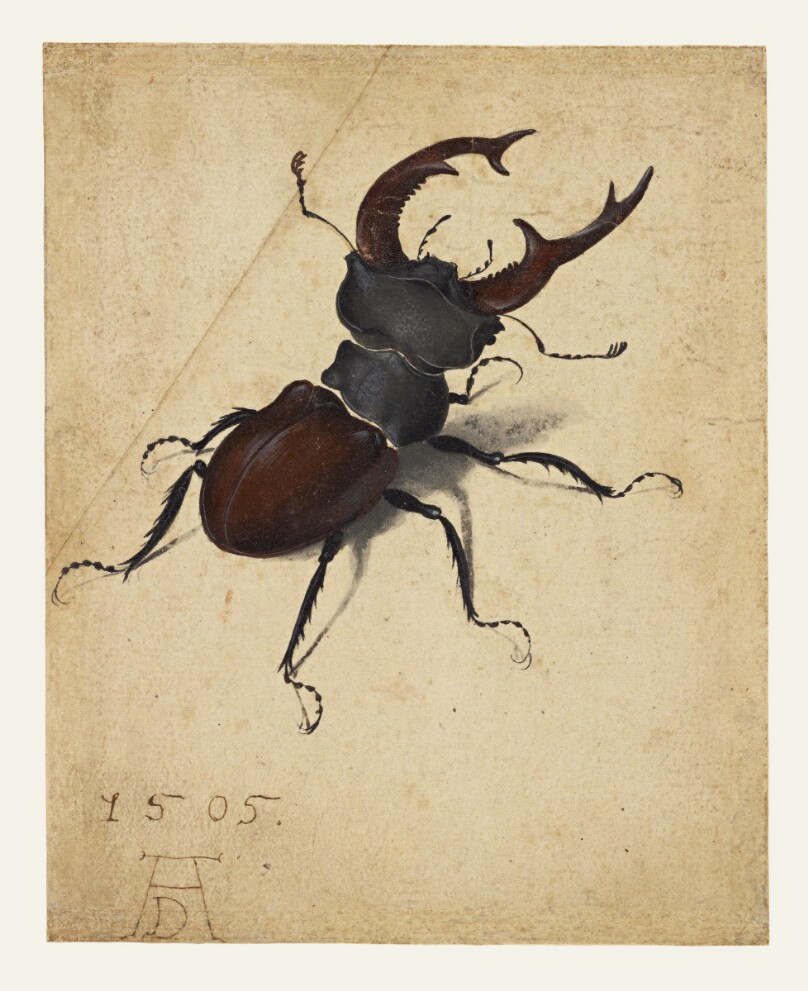
In 1505, Albrecht Dürer devoted an entire sheet to a single beetle - a creature his contemporaries considered among the lowest forms of life. Using watercolor and gouache, he built up the hard, convex wing cases with bodycolor and captured the shadow cast by six jointed legs lifting the body clear off the page. The mandibles and spiky limbs give the insect an almost heroic presence. This drawing helped establish serious observation of nature as a legitimate artistic act, and artists were still copying it centuries later.
Written by LinkedCulture for its video on this object. Machine-generated (claude-sonnet-4-6), not yet reviewed by a person. It is not part of the museum’s record.
From the Getty Museum record
"It is indeed true," wrote Albrecht Dürer, "that art is omnipresent in nature, and the true artist is he who can bring it out." The *Stag Beetle* is one of Dürer's most influential and most copied nature studies. Singling out a beetle as the focal point of a work of art was unprecedented in 1505, when most of Dürer's contemporaries believed that insects were the lowest of creatures. Dürer's keen interest in nature, however, was a typical manifestation of the Renaissance. This beetle, rendered with such care and respect, seems almost heroic as he looms above the page. Dürer probably made this drawing in the studio, based on quick sketches from nature and memory. The level of finish shows that he considered it an independent work of art, not a preparatory study. He used bodycolor to show volume, as in the hard, convex outer wings. Transparent washes represent light effects, such as the shadow cast by the body, which the legs raise off the ground. Seen up close, the creature's legs and spiky mandibles suggest its kinship to imaginary beasts in late Gothic depictions of Hell or the temptation of Saint Anthony Abbott.
The authoritative record is held by Getty Museum. LinkedCulture surfaces this object and its connections; it does not alter institutional metadata.
Get printable QR codesHide QR codes
Open QR codes for this object page and the museum record. They stay collapsed until needed.
Related across collections
Semantically similar works from Getty Museum and other institutions.