Getty Museum
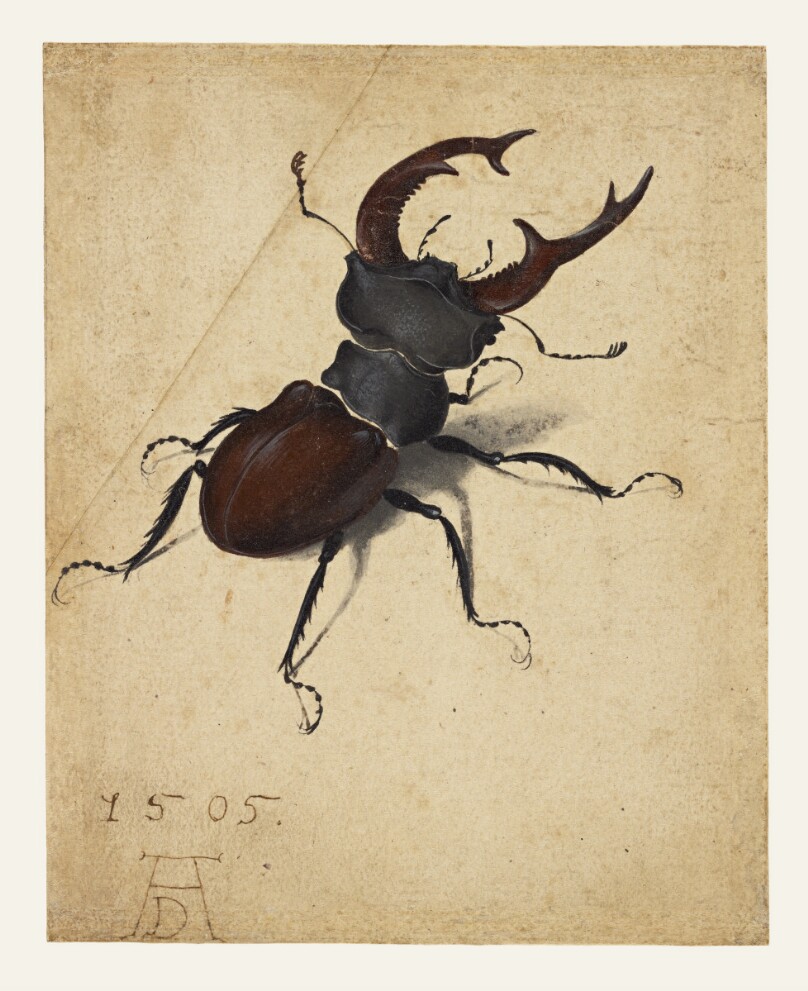
Stag Beetle
Creator
Albrecht DürerGerman Artist · 1471–1528
All works by this person →> In Venice, I am treated as a nobleman. . . . Here I really am somebody, whereas at home I am just a hack." > >-Albrecht Dürer > > Though Dürer lamented Germany's medieval conception of artists, Italian Renaissance ideas first came north in a powerful way through him. Dürer initially trained in Nuremberg as a goldsmith, painter, and woodcutter. After visiting Venice in 1495, he intensely studied
More on Getty ULANObject Description · Getty Museum
Getty Museum’s catalogue record
- produced_by.carried_out_by[0].id
- https://data.getty.edu/museum/collection/person/eebbc65a-3440-46c7-afac-b214bd3ccc79
- Artist/Maker
- Albrecht Dürer
- subject_of[Homepage].id
- https://www.getty.edu/art/collection/object/103QS6
- Date
- 1505
- Medium
- Watercolor and gouache; upper left corner of paper added, with tip of left antenna painted in by a later hand
- Culture
- German
- Object Type
- Drawing
Taken from LinkedCulture’s stored copy of Getty Museum’s record. A fresh capture of the museum’s own record has not been made for this object yet.
From LinkedCulture
In 1505, Albrecht Dürer devoted an entire sheet to a single beetle - a creature his contemporaries considered among the lowest forms of life. Using watercolor and gouache, he built up the hard, convex wing cases with bodycolor and captured the shadow cast by six jointed legs lifting the body clear off the page. The mandibles and spiky limbs give the insect an almost heroic presence. This drawing helped establish serious observation of nature as a legitimate artistic act, and artists were still copying it centuries later.
Written by LinkedCulture for its video on this object. Machine-generated (claude-sonnet-4-6), not yet reviewed by a person. It is not part of the museum’s record.
The authoritative record is held by Getty Museum. LinkedCulture surfaces this object and its connections; it does not alter institutional metadata. The fields above are the museum’s, under its own labels. LinkedCulture’s derived fields are listed separately below and marked as ours.
Get printable QR codesHide QR codes
Open QR codes for this object page and the museum record. They stay collapsed until needed.
How LinkedCulture maps this record
To search objects from different museums together, LinkedCulture reads each museum’s record into a common set of fields. The values below are LinkedCulture’s, under LinkedCulture’s names. They are not Getty Museum’s wording; the museum’s own record is shown above under its own labels.
- Object ID
- 8a467f7a-c019-409c-9ee5-f41528562591
- Object Type
- Drawing
- Getty Museum field “Object Type” · copied as is
- Creator
- Albrecht Dürer
- Getty Museum field “Artist/Maker” · copied as is
- Culture
- German
- Getty Museum field “Culture” · copied as is
- Medium
- Watercolor and gouache; upper left corner of paper added, with tip of left antenna painted in by a later hand
- Getty Museum field “Medium” · copied as is
- Department
- Drawings
- Getty Museum field “Department” · derived by LinkedCulture from the museum field · Getty's classification category is stored as department.
- Credit Line
- The J. Paul Getty Museum, Los Angeles
- Getty Museum field “Standard Credit Line” · the first available of several museum fields
- Getty Museum field “Source Credit Line” · the first available of several museum fields
- Date
- 1505
- Getty Museum field “Date” · copied as is
- Begin Year
- 1505
- Getty Museum field “produced_by.timespan.begin_of_the_begin” · derived by LinkedCulture from the museum field
- End Year
- 1505
- Getty Museum field “produced_by.timespan.end_of_the_end” · derived by LinkedCulture from the museum field
The museum’s own record has not been captured for this object yet, so the museum fields shown above are limited to values LinkedCulture stored unchanged.
Related across collections
Semantically similar works from Getty Museum and other institutions.