Getty Museum
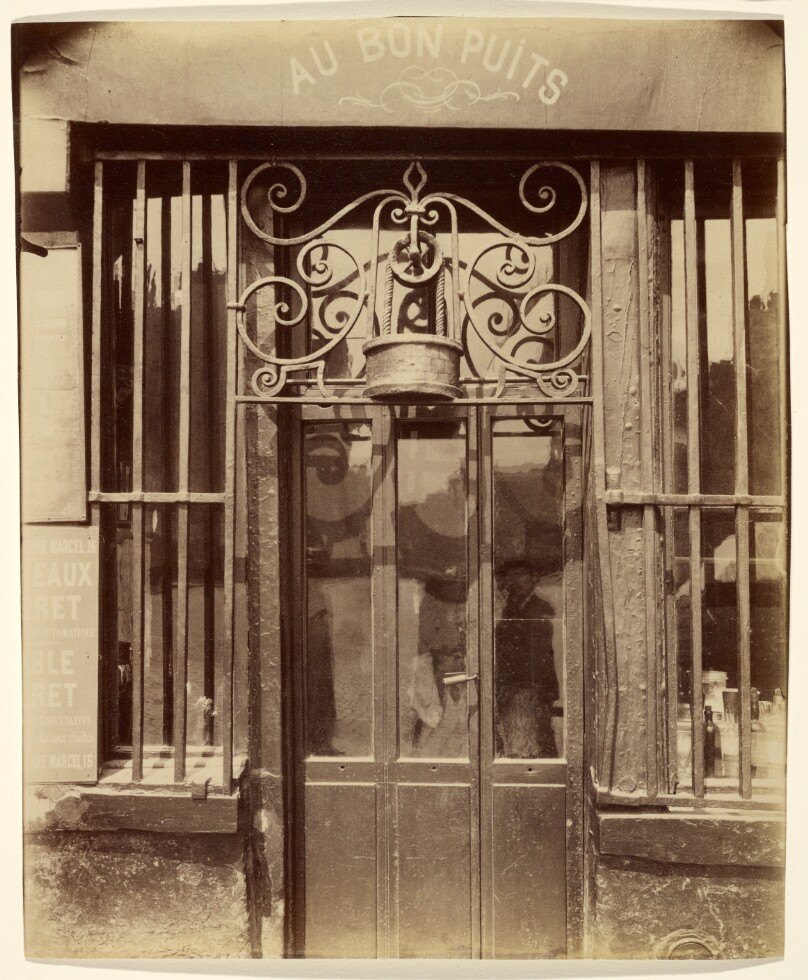
Au bon puits, rue Michel Le Conte, 36 (IIIe)
Creator
Eugène AtgetFrench Photographer · 1857–1927
All works by this person →Eugène Atget never called himself a photographer; instead he preferred "author-producer." A private, almost reclusive man, Atget first tried his hand at painting and acting, then began to photograph *vieux Paris* (Old Paris) in 1898. He photographed in part to create "documents," as he called his photographs, of architecture and urban views, but he supported himself by selling these photographs to
More on Getty ULAN- Date
- 1901
- Medium
- Albumen silver print
- Culture
- French
- Department
- Photographs
- Institution
- Getty Museum
- Object ID
- 8ad2dd32-5279-4577-b3ce-0d6ae9603b1c
From the Getty Museum record
> Eugène Atget photographed this shop front primarily in order to record the seventeenth-century wrought iron sign depicting a pulley, shallow bucket, and rope. The liquid to be drawn up "At the Good Well" (*Au Bon Puits*) was not water but wine. The establishment was for a long time a famous cabaret, which closed in 1906, five years after Atget made this view. Its marker, however, was salvaged and is now part of a collection in the Musée Carnavalet of shop signs that used visual symbols rather than words to announce wares to members of the public, only some of whom were literate in the 1600s. Atget made a series of photographs of these signs, which he recognized were in the process of disappearing (see also [90.XM.124.13](https://www.getty.edu/art/collection/objects/64719/eugene-atget-petit-bacchus-61-rue-st-louis-en-l'ile-the-little-bacchus-cafe-rue-st-louis-en-l'ile-french-1901-1902/)). > > It seems likely that the silhouette seen in the windowpane just to the right of the door handle is the reflection of the photographer in the street standing sideways to his camera and tripod, which can indistinctly be seen in the center panel (zoom in on image above). Judging by the height of the handle, the figure is some distance away from the door, far enough so that if he were inside the shop he would be lost in shadow. This makes the picture a discreet but not unintentional self-portrait. Given the large number of photographs that he made of storefronts, it is not surprising that fragmented reflections of Atget or his camera occasionally occur, but these other glimpses seem incidental, not purposeful. > > Adapted from *Eugène Atget*, In Focus: Photographs from the J. Paul Getty Museum by Gordon Baldwin (Los Angeles: J. Paul Getty Museum, 2000), 20. ©2000, J. Paul Getty Trust.
The authoritative record is held by Getty Museum. LinkedCulture surfaces this object and its connections; it does not alter institutional metadata.
Get printable QR codesHide QR codes
Open QR codes for this object page and the museum record. They stay collapsed until needed.
Related across collections
Semantically similar works from Getty Museum and other institutions.