Getty Museum
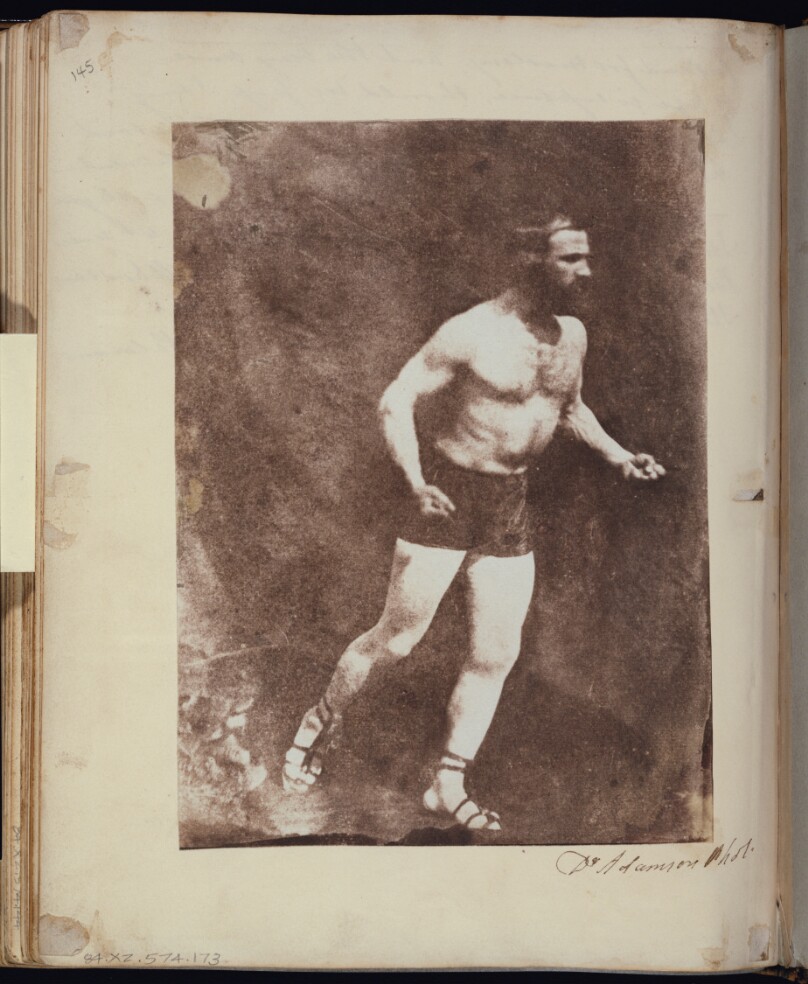
An Athlete
Creator
Dr. John AdamsonPhotographer · 1810–1870
All works by this person →John Adamson was a medical doctor and curator of the St. Andrews Literary and Philosophical Society Museum in Scotland from its formation in 1838 until his death in 1870. The Society was an eclectic group of intellectuals with a wide variety of interests; at its meetings, Adamson learned of the invention of photography from Sir David Brewster. Brewster, the newly appointed principal of the St. And
More on Getty ULAN- Date
- about 1845
- Medium
- Salted paper print from a paper negative
- Culture
- Scottish
- Department
- Photographs
- Institution
- Getty Museum
- Object ID
- 8c40170a-c820-4f6d-bbf0-93220d8a16da
From the Getty Museum record
> Although the chief discoveries that led to photography were made within a hundred-mile radius of either London or Paris, the British and French capitals were not the exclusive domains of significant innovation. Sir John Herschel introduced William Henry Fox Talbot to David Brewster, who was one of Scotland's most renowned scientists of the early nineteenth century. Talbot and Brewster became fast friends. Talbot shared details of his work that Brewster in turn communicated to his circle in the St. Andrews Literary and Historical Society. Among them was John Adamson, a physician with no apparent training in art who nonetheless created two masterful works of early photography. ([84.XZ.574.67](http://www.getty.edu/art/collection/objects/63246)) > > One of them is an untitled photograph now known as *An Athlete*. It shows a male figure dressed in shorts and wearing Roman sandals who appears to be lunging or striding forward. His fists are clenched, and the veins in his left forearm bulge with the tension. The anonymous model may the first person ever to be photographed in a way that expresses animation rather than the static immobility that the slow processes of early photography required. We are not seeing actual motion that has been arrested, but rather a cleverly staged illusion. > > With its close attention to details of the human body posed to appear in motion, this photograph may have been intended as a painter's or sculptor's reference tool. Adamson seems to have been exploring both the possible achievements and applications of this new medium. Adapted from Weston Naef, *The J. Paul Getty Museum Handbook of the Photographs Collection* (Los Angeles: J. Paul Getty Museum, 1995), 21. © 1995 The J. Paul Getty Museum.
The authoritative record is held by Getty Museum. LinkedCulture surfaces this object and its connections; it does not alter institutional metadata.
Get printable QR codesHide QR codes
Open QR codes for this object page and the museum record. They stay collapsed until needed.
Related across collections
Semantically similar works from Getty Museum and other institutions.