Getty Museum
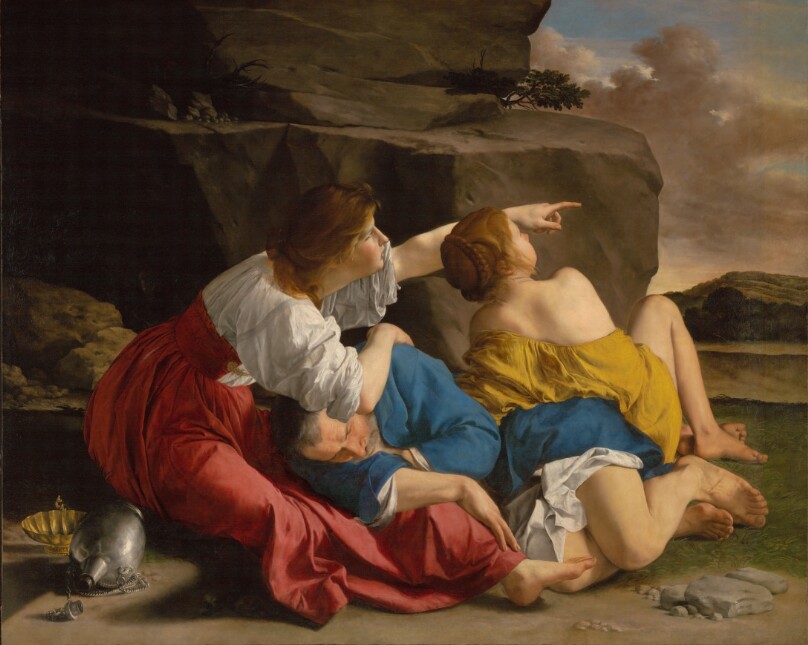
Lot and His Daughters
Creator
Orazio GentileschiItalian Artist · 1563–1639
All works by this person →Orazio Gentileschi apparently came to painting only in his early twenties, and by the late 1570s or early 1580s he was painting figures in fresco in several Roman churches. During the early 1600s, simplicity of composition, clear, precise contours, and a rich blend of bright, cool, and warm colors characterized his art. By late 1622 Gentileschi had moved to Genoa, where he worked for the duke of S
More on Getty ULAN- Date
- about 1622
- Medium
- Oil on canvas
- Culture
- Italian
- Department
- Paintings
- Institution
- Getty Museum
- Object ID
- 8cc22019-c330-4169-99b5-3b9f97484895
From the Getty Museum record
From the safety of the cave where they have taken refuge, Lot’s daughters appear absorbed by an event taking place beyond the painting’s borders—God’s annihilation of the city of Sodom, burning in the distance. Believing that they alone survive to perpetuate the human race, the daughters have plied their father with alcohol, to aid their incestuous seduction of him. Each will later bear Lot a son: Moab and Ammon, the founders of tribes often pitted against Israel. Depictions of Lot and his Daughters were popular in seventeenth-century Europe because they provided a righteous context in which to illustrate a social taboo. The subject is often interpreted as a mere pretext for artists to engage with an erotic theme, but the absence of nudity or palpable sensuality in this scene suggests that Gentileschi’s intentions were otherwise. Gentileschi was born in Pisa, but settled in Rome in about 1576. From around 1600, he began to absorb the powerful naturalism of Caravaggio, subsequently becoming one of his closest and most successful followers. However, Gentileschi never gave himself over fully to the uncompromising Caravaggesque style, and maintained traits more characteristic of his native Tuscany; a poetic, refined aesthetic that incorporated a rich blend of highly pitched cool and warm colors. A pendant piece to this work, *[Danaë and the Shower of Gold](http://www.getty.edu/art/collection/objects/133975/)* is also in the Getty’s collection. Both paintings were commissioned by the nobleman Giovanni Antonio Sauli in 1621 for his Palazzo in Genoa, along with a third, *The Penitent Magdalene*, which is today in a private collection.
The authoritative record is held by Getty Museum. LinkedCulture surfaces this object and its connections; it does not alter institutional metadata.
Get printable QR codesHide QR codes
Open QR codes for this object page and the museum record. They stay collapsed until needed.
Related across collections
Semantically similar works from Getty Museum and other institutions.