Getty Museum
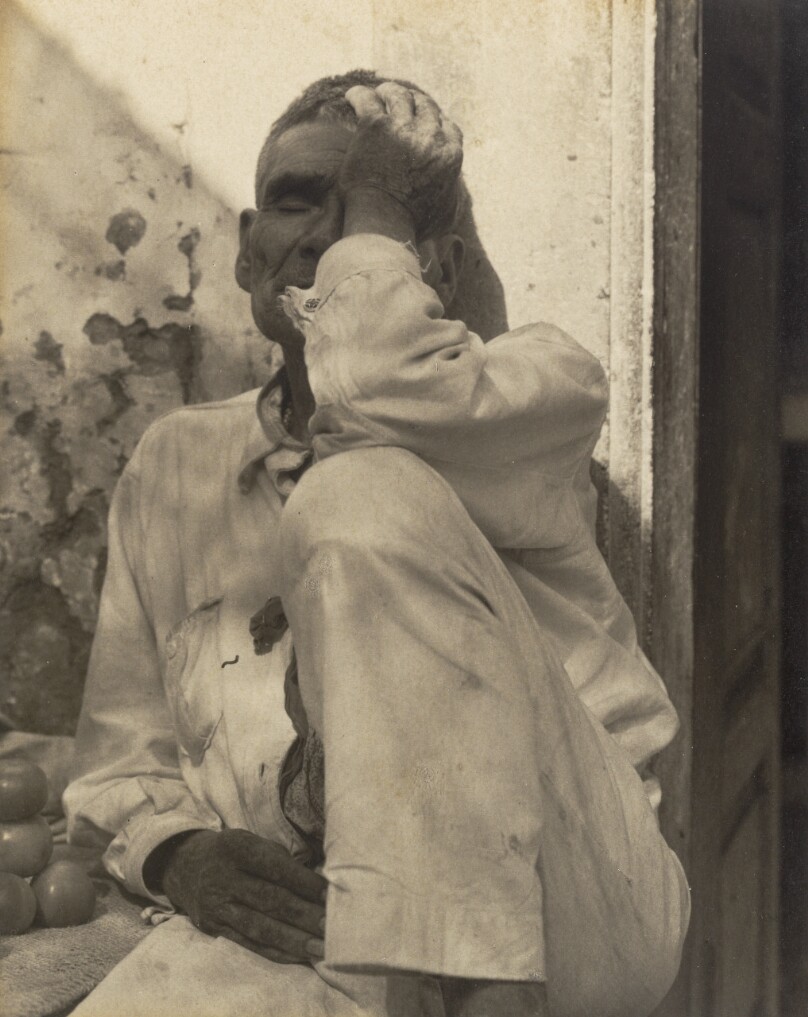
Seated Man, Uruapan del Progreso, Michoacán, Mexico
Creator
Paul StrandAmerican Photographer · 1890–1976
All works by this person →Paul Strand began photographing in New York in the 1910s. During the early 1920s he received recognition for both his painting and his photography. He visited New Mexico in 1926 and, beginning in 1930, returned for three consecutive summers, making portraits of artist friends and acquaintances. It was there, amidst a community of visual artists and writers, that Strand began to develop his belief
More on Getty ULAN- Date
- 1933
- Medium
- Platinum print
- Culture
- American
- Department
- Photographs
- Institution
- Getty Museum
- Object ID
- 8fac3f1a-0d46-4277-821f-5a1bff58f6ca
From the Getty Museum record
Traveling around Mexico, Paul Strand was interested in documenting the life he encountered in the country's numerous small towns. He was also interested in capturing the steadfast qualities of the people. He was searching for those individuals whose lives were marked by struggle, persons who sought to preserve themselves and their customs despite the changing world around them. By moving closer to the subjects and filling his frame with their presence, Strand seems to acknowledge their inherent heroic qualities, as shown in this image and in [_The Sisters, Ocoyoacac, Mexico_](https://www.getty.edu/art/collection/object/106NR4). There is little contextual background in the photographs; the poses, faces, gestures, and costumes are dispassionately recorded against abraded walls, as if to further suggest the hardships the people endure. Strand's Mexican portraits recall the series of Newhaven photographs David Octavius Hill (1802-1870) and Robert Adamson (1821-1848) made between 1843 and 1847 (see [84.XM.966.8](https://www.getty.edu/art/collection/object/104AEZ) and [84.XM.966.10](https://www.getty.edu/art/collection/object/104AF2)). Strand was familiar with some of their pictures, which were published as photogravures in _Camera Work_, and in 1931 he had written a review of Heinrich Schwarz's book _David Octavius Hill: Master of Photography_ for the Saturday Review of Literature. While the newness of the photographic medium may have engendered a natural and spontaneous response to Hill and Adamson's camera in 1843, Strand could not be assured of such a pure and genuine reaction almost one hundred years later. He reverted to the working method he had first employed on the streets of New York in 1916, this time utilizing a special mirror lens inside the camera. The result was that his subjects were not aware, for the most part, that they were being photographed, so their appearance is completely candid and unprompted. Adapted from _Paul Strand_, In Focus: Photographs from the J. Paul Getty Museum by Anne M. Lyden (Los Angeles: J. Paul Getty Museum, 2005), 50. ©2005, J. Paul Getty Trust.
The authoritative record is held by Getty Museum. LinkedCulture surfaces this object and its connections; it does not alter institutional metadata.
Get printable QR codesHide QR codes
Open QR codes for this object page and the museum record. They stay collapsed until needed.
Related across collections
Semantically similar works from Getty Museum and other institutions.