Getty Museum
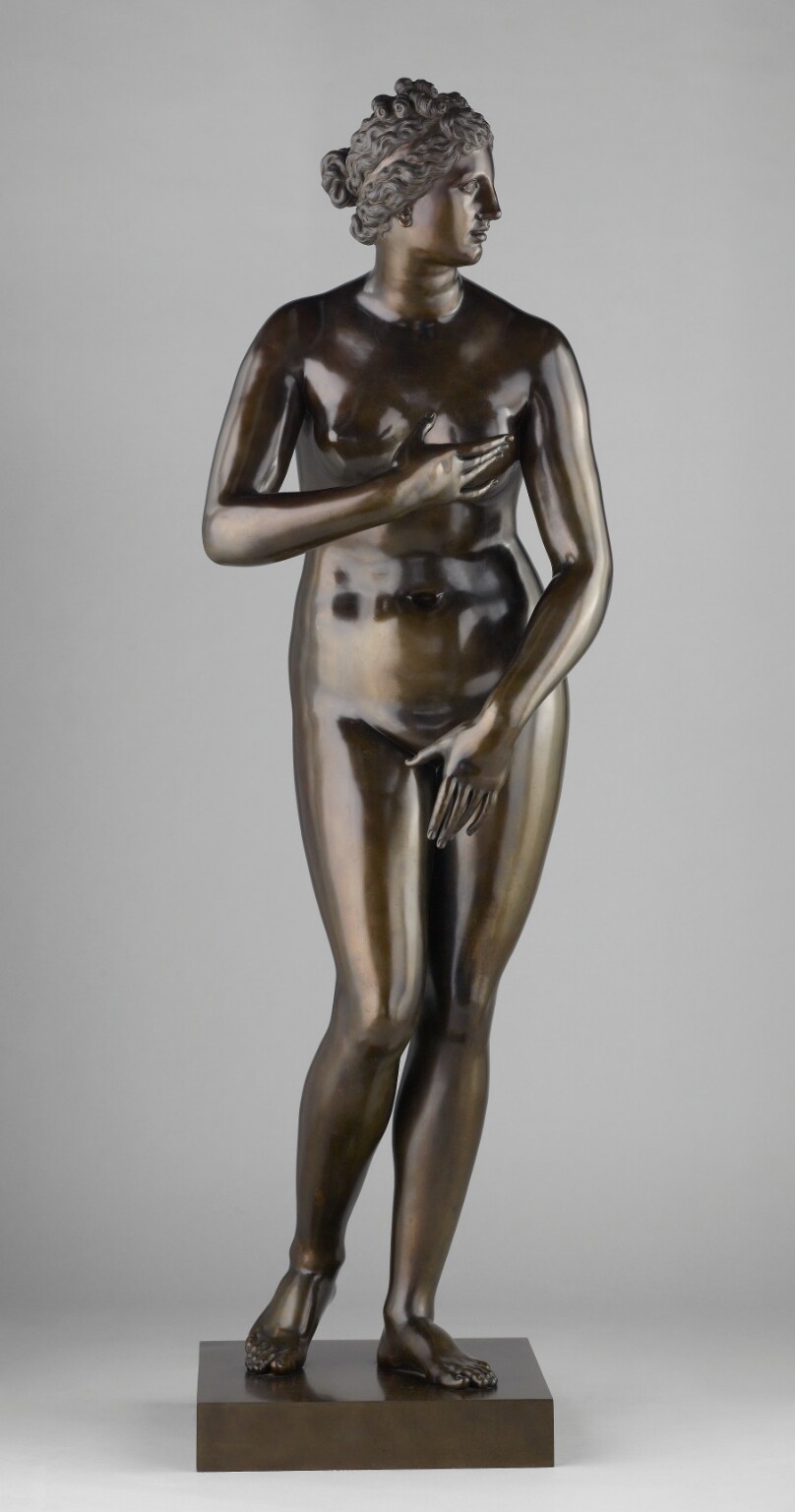
Medici Venus
Creator
Pietro CiprianiItalian Artist · 1680–1745
All works by this person →Many art historians consider Cipriani as the most gifted bronze sculptor of his generation in Florence. Before his works *Venus de' Medici* and the *Dancing Faun* were first published in 1998, together with a number of other bronzes cast for the Earl of Macclesfield, the artist was little known, although several documents about his activity had been previously published. Notably, in 1709 Cipriani
More on Getty ULAN- Date
- 1722–1724
- Medium
- Bronze
- Culture
- Italian
- Department
- Sculpture
- Institution
- Getty Museum
- Object ID
- 8fad1cd2-e274-49ef-87d7-7b75d030d74b
From the Getty Museum record
Severe yet sensual, the Roman goddess of Love's well-modeled, undulating curls and upswept hair provide a delicate contrast to the unblemished skin which is polished to a high shine. Shown in a gesture of modesty as if suddenly surprised, she appears in a classic pose known as the "chaste Venus" or Medici Venus after a famous life-size Hellenistic marble. Her eyes are slightly textured giving them the appearance of depth. The artist's name is inscribed in Latin on the plinth, or supporting base, of the sculpture. The Medici Venus--along with Cipriani's *Dancing Faun* --was created for display at Shirburn Castle in Oxfordshire, the seat or country house of the patron for these works. After casting, the artist destroyed the original plasters to prevent a second use, making the works even more extraordinary. Whereas many such sculptures were displayed unprotected outdoors in gardens, these were not. The condition of the bronze has therefore retained much of the freshness of its original appearance, without staining or pitting of the surface. Cipriani's Medici Venus is based on a Hellenistic statue that has been on display in the Uffizi Gallery in Florence since the second half of the 1600's. Such copies of Greco-Roman statuary were popular among contemporary wealthy art collectors who wanted their own versions of ancient art seen during their travels in Europe and Greece on what was known as the "grand tour." This particular sculpture, however, takes the "souvenir" type to the extreme, as it is a large, full-scale work, difficult to transport, and of such high artistic quality. In the marble version, the work features a support to Venus's leg in the form of a putto riding a dolphin. Cipriani eliminates this element, whose stability is not required in the bronze medium. Some scholars see his choice as possibly inspired by the notion that the ancient marbles were actually copies of lost bronze originals.
The authoritative record is held by Getty Museum. LinkedCulture surfaces this object and its connections; it does not alter institutional metadata.
Get printable QR codesHide QR codes
Open QR codes for this object page and the museum record. They stay collapsed until needed.
Related across collections
Semantically similar works from Getty Museum and other institutions.