Getty Museum
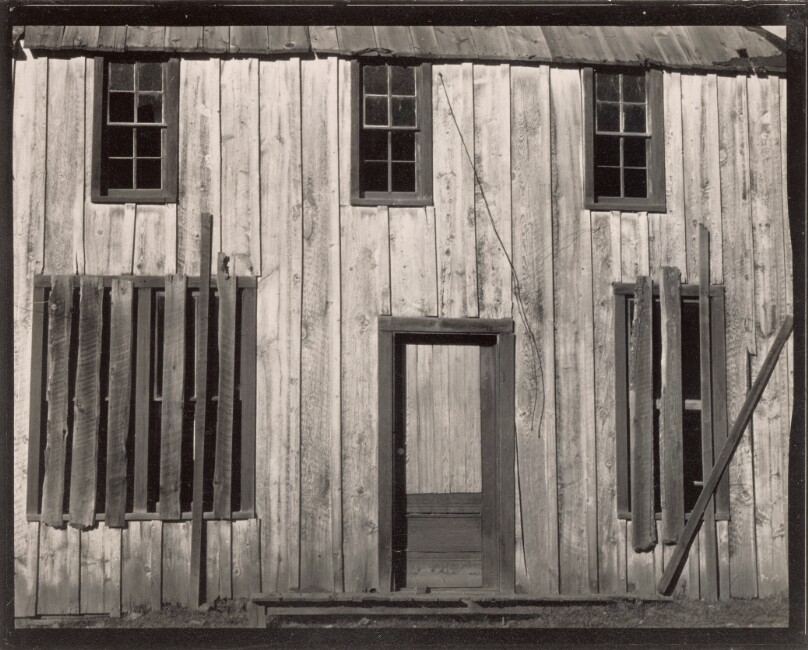
Ghost Town, Red River, New Mexico
Creator
Paul StrandAmerican Photographer · 1890–1976
All works by this person →Paul Strand began photographing in New York in the 1910s. During the early 1920s he received recognition for both his painting and his photography. He visited New Mexico in 1926 and, beginning in 1930, returned for three consecutive summers, making portraits of artist friends and acquaintances. It was there, amidst a community of visual artists and writers, that Strand began to develop his belief
More on Getty ULAN- Date
- 1931
- Medium
- Gelatin silver print
- Culture
- American
- Department
- Photographs
- Institution
- Getty Museum
- Object ID
- 924e0a9f-28b0-446a-b0e2-f7239ab4f342
From the Getty Museum record
Red River, situated at the southern edge of the Sangre de Cristo Mountains in New Mexico, started as a gold mining camp in the 1890s. In just a few years it had grown to the size of a small town, boasting such amenities as saloons, general stores, hotels, a dance hall, and a hospital. By the time Paul Strand visited the town in the early 1930s, the mining boom had long since passed, having left in its wake a sleepy little hamlet, which was now changing into a popular mountain retreat. Strand was interested in the area's natural beauty and the abandoned structures left over from the mining days. In writing to his friend Herbert Seligman (1891-1984) during the summer of 1931, Strand spoke of the false-front buildings in Red River as representing a courage and dignity of a past life. Similar to an approach he had taken in Gaspé, Strand was now continuing to explore the idea of recording a place that was separate from the modern world. Here, working with his versatile Graflex camera, Strand fills the composition with a boarded-up building, the weathered wooden clapboards washed in strong sunlight. The work is reminiscent of Charles Sheeler's studies of barns in Bucks County, Pennsylvania, from 1917 ([88.XM.22.4](https://www.getty.edu/art/collection/object/104EAB), [88.XM.22.1](https://www.getty.edu/art/collection/object/104EA9)), but Strand goes a step further and removes any contextual information from the scene. He brings everything to the foreground and omits perspectival depth so that the resulting abstract composition appears on one plane, giving the surface of the print a decorative quality. Originally published in _Paul Strand_, In Focus: Photographs from the J. Paul Getty Museum by Anne M. Lyden (Los Angeles: J. Paul Getty Museum, 2005), 44. ©2005, J. Paul Getty Trust.
The authoritative record is held by Getty Museum. LinkedCulture surfaces this object and its connections; it does not alter institutional metadata.
Get printable QR codesHide QR codes
Open QR codes for this object page and the museum record. They stay collapsed until needed.
Related across collections
Semantically similar works from Getty Museum and other institutions.