Getty Museum
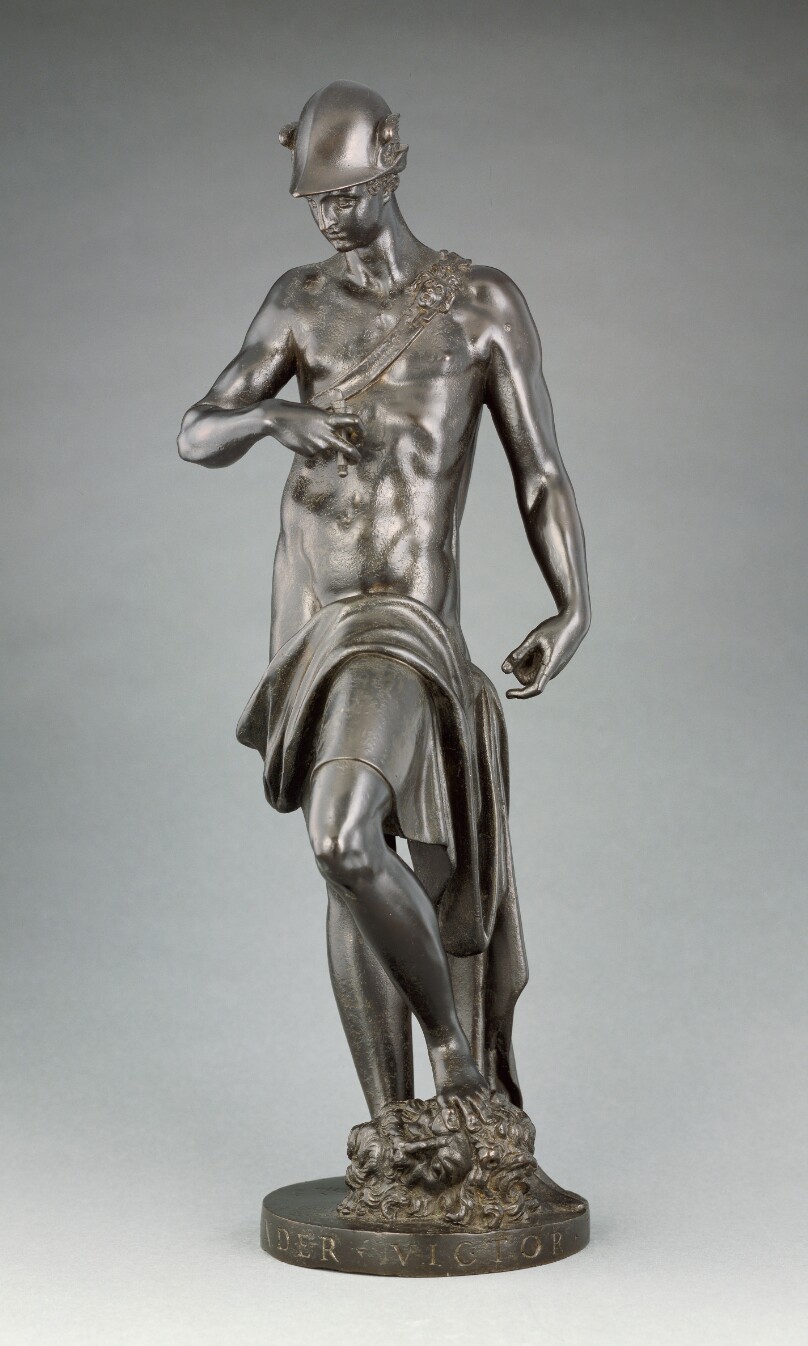
Mercury
Creator
Alessandro VittoriaItalian Artist · 1525–1608
All works by this person →The son of a tailor in the Italian city of Trent, Alessandro Vittoria became one of the dominant artists in Venice from 1550 to 1600. After apprenticing to sculptors in his hometown, Vittoria moved to Venice, where he worked on commissions for both aristocratic patrons and the churches of Venice in the studio of Jacopo Sansovino. By 1550, he was an independent master. Following a quarrel with Sans
More on Getty ULAN- Date
- 1559–1560
- Medium
- Bronze
- Culture
- Italian
- Department
- Sculpture
- Institution
- Getty Museum
- Object ID
- 927dfc1f-3202-4c21-8045-0fff9c0e8d1a
From the Getty Museum record
Mercury, god of science, commerce, and travel in Greek and Roman mythology, was messenger to the god Jupiter. Identified by his winged helmet, he originally held a caduceus, which is now broken. His raised left foot rests on the head of the monster Argus, whom Mercury killed to free one of Jupiter's lovers. The young god's lithe, elongated body and the pronounced shift of his body weight from one leg to the other are characteristic features of the Mannerist style. The figure's downward glance suggests that the original work was meant to be executed on a larger scale and to be seen from below. Alessandro Vittoria probably designed this freestanding figure and a bronze Minerva as pendants, both of which he signed. The drapery support behind the figure suggests that the bronze is a copy of a work originally carved in marble and then reproduced in metal. In marble statues a support bears the weight of the piece, but it has no function in bronze statues. The bronze bears little evidence of work after the casting. All the details were worked out in the wax core, attesting to the high quality of the casting technique.
The authoritative record is held by Getty Museum. LinkedCulture surfaces this object and its connections; it does not alter institutional metadata.
Get printable QR codesHide QR codes
Open QR codes for this object page and the museum record. They stay collapsed until needed.
Related across collections
Semantically similar works from Getty Museum and other institutions.