Getty Museum
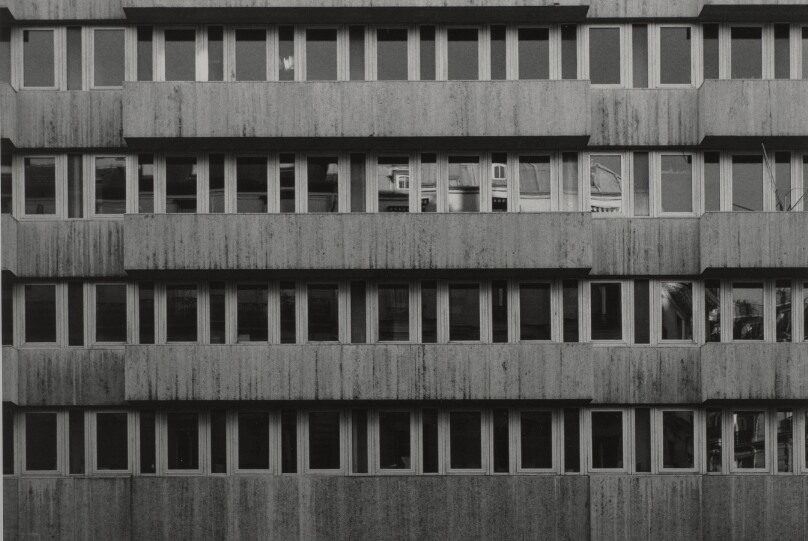
Vie d’Alphonse Bertillon #19
Creator
Stéphanie SolinasFrench Photographer · 1978–present
All works by this person →- Date
- negative 2012; print 2023
- Medium
- Gelatin silver print and digital sound files
- Culture
- French
- Department
- Photographs
- Institution
- Getty Museum
- Object ID
- 93689b81-54ac-45ca-9400-0db5237e23f5
From the Getty Museum record
> On the 17th October, 1902, somebody broke into a Parisian dentist's domicile. The criminal assassinated the servant and then took flight with several previous objects stolen from a glass case he had shattered, without leaving any apparent clues for one to set on his traces. Alphonse Bertillon, who had been called to the scene of the crime to take photographs, was immediately attracted by the broken glass. He took a few pieces as carefully as possible upon which he had noticed traces of finger prints. Once in his service, he took photographs of them, which he then spent a long time contemplating. He remembered the famous saying: “The same crimes are generally committed by the same criminals.” “Let’s go and see,” he said to himself. He consulted all the files of assassins and thieves whose crimes were similar to the dentist’s. These files gave him the names of criminals who had already been arrested. The alphabetic directory enabled him to find their files. Certain files had been completed with the addition of finger prints. Alphonse Bertillon undertook a long, meticulous study of them, comparing the imprints with those he had found on the pieces of glass. His patience was rewarded. He found a file in the name of Scheffer whose prints corresponded exactly to those found on the pieces of glass. > > Transcript of the audio that accompanies this photograph. The excerpt is from Suzanne Bertillon, *Life of Alphonse Bertillon: Inventor of Anthropometry* (Paris: Gallimard, 1941) as translated by Emmelene Landon and published in Stéphanie Solinas, *Sans Titre, M. Bertillon* (Paris: RVB Books, 2011). Text © Suzanne Bertillon, Gallimard. All rights reserved. In the 1880s Frenchman Alphonse Bertillon (1853-1914), an employee at the Paris Prefecture of Police, developed a method to identify repeat criminals that involved photographing and taking measurements of the individuals. He also introduced photography as a crucial tool in crime scene investigations. His theories and techniques have evolved into the multitude of methods of identification that are used on us all today. For the series Untitled (M. Bertillon), Stéphanie Solinas turned the tables on Bertillon by photographing sites of importance from his life as if she were studying crime scenes. Each of the twenty-three photographs has an audio component—an excerpt from Bertillon’s biography written by his niece Suzanne Bertillon (see the excerpt above). Solinas describes this series as “spoken pictures.” She also ran two mugshot-type portraits of Bertillon’s face and profile through facial analysis software to re-create a three-dimensional photographic sculpture [2023.55] that captures his piercing gaze. Carolyn Peter, J. Paul Getty Museum, Department of Photographs, 2024
The authoritative record is held by Getty Museum. LinkedCulture surfaces this object and its connections; it does not alter institutional metadata.
Get printable QR codesHide QR codes
Open QR codes for this object page and the museum record. They stay collapsed until needed.
Related across collections
Semantically similar works from Getty Museum and other institutions.