Getty Museum
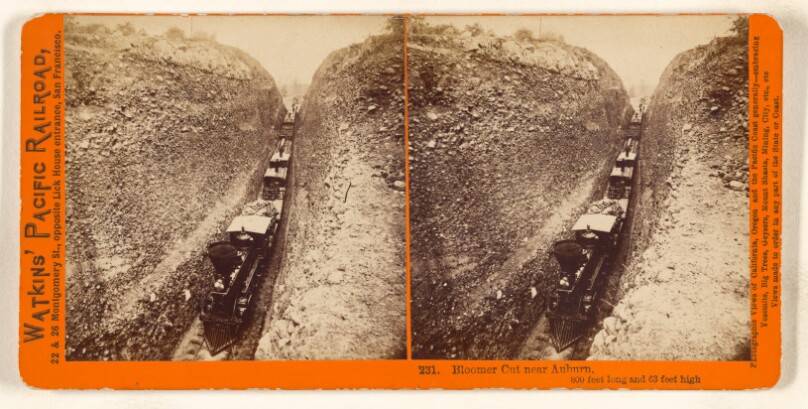
Bloomer Cut near Auburn, 800 feet long and 63 feet high.
- Date
- 1866–1869
- Medium
- Albumen silver print
- Culture
- American
- Department
- Photographs
- Institution
- Getty Museum
- Object ID
- 93ad87bc-3da4-4bf0-9007-552399e0583c
From the Getty Museum record
In 1862 an Indiana state representative stated that the transcontinental railway "could never be constructed on terms applicable to ordinary roads . . . . It is to be constructed through almost impassible mountains, deep ravines, canyons, gorges, and over arid and sandy plains." Photographers like Alfred A. Hart documented the staggering constructions that, before the railroad, no one had imagined possible. Blasting through a naturally cemented part of the Sierra Nevada mountain range, crews of the Central Pacific Railroad built this immense corridor, sixty-three feet deep and eight hundred feet long. Though Hart made this stereograph, its mount bears Carleton E. Watkins's name. Watkins was a San Francisco-based photographer who also chose the railroad as a primary subject. Because Hart's negatives belonged to the Central Pacific Railroad, they were subsequently printed by other company photographers who, like Watkins, failed to properly credit Hart.
The authoritative record is held by Getty Museum. LinkedCulture surfaces this object and its connections; it does not alter institutional metadata.
Get printable QR codesHide QR codes
Open QR codes for this object page and the museum record. They stay collapsed until needed.
Related across collections
Semantically similar works from Getty Museum and other institutions.