Getty Museum
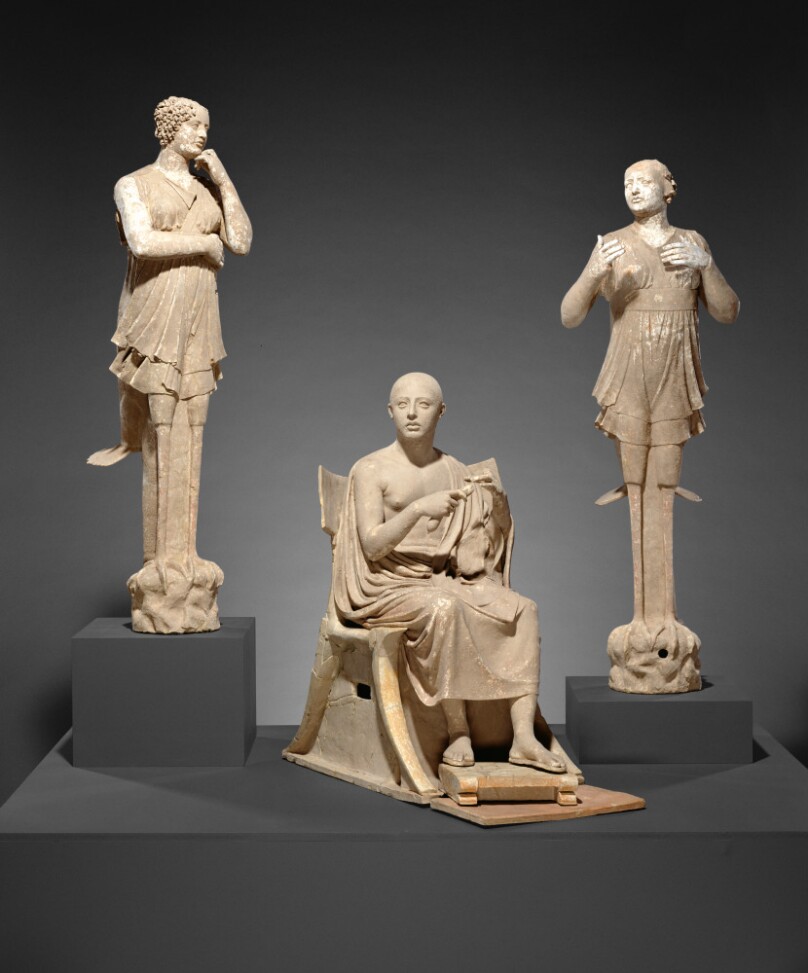
Sculptural Group of a Seated Poet and Sirens (2) with unjoined fragmentary curls (304) and shells (2)
Creator
UnknownAll works by this person →More on Getty ULAN- Date
- 350–300 B.C.
- Medium
- Terracotta with white slip of calcium carbonate and polychromy (orange-gold, black, red, gold-yellow, brown, pink)
- Culture
- Greek (Tarantine)
- Department
- Sculpture
- Institution
- Getty Museum
- Object ID
- 949f750f-7d34-4b3e-8b13-9e6e88a220a8
From the Getty Museum record
A seated man is flanked by Sirens, creatures part bird and part woman, in this nearly life-size terracotta group. In Greek mythology, the singing of the Sirens lured sailors to their deaths, and so these mythical figures are often connected with the deceased. The seated man is also a singer, as shown by his open mouth and the pick (plektron) with which he plays his now-missing lyre, once cradled in his left arm. His precise identity, however, is uncertain. He might be Orpheus, who was famous for his singing and who helped Jason and his crew safely sail past the Sirens. But in art of the fourth century BC, Orpheus is usually shown wearing an elaborately embroidered costume that is not seen here. Therefore, the seated figure may be a mortal in the guise of a poet or singer. The precise meaning of the group has been the subject of extensive speculation, but perhaps the singer should be seen as prevailing over the Sirens and triumphing over death. It is likely that the group was made for a tomb. Originally brightly painted, it is an exceptional example of the terracotta sculpture characteristic of the Greek colonies in South Italy. Although terracotta sculpture is also found in mainland Greece, artists in the Greek colonies in South Italy used this medium with greater frequency and on a larger scale because there were few sources of good stone suitable for sculpting.
The authoritative record is held by Getty Museum. LinkedCulture surfaces this object and its connections; it does not alter institutional metadata.
Get printable QR codesHide QR codes
Open QR codes for this object page and the museum record. They stay collapsed until needed.
Related across collections
Semantically similar works from Getty Museum and other institutions.