Getty Museum
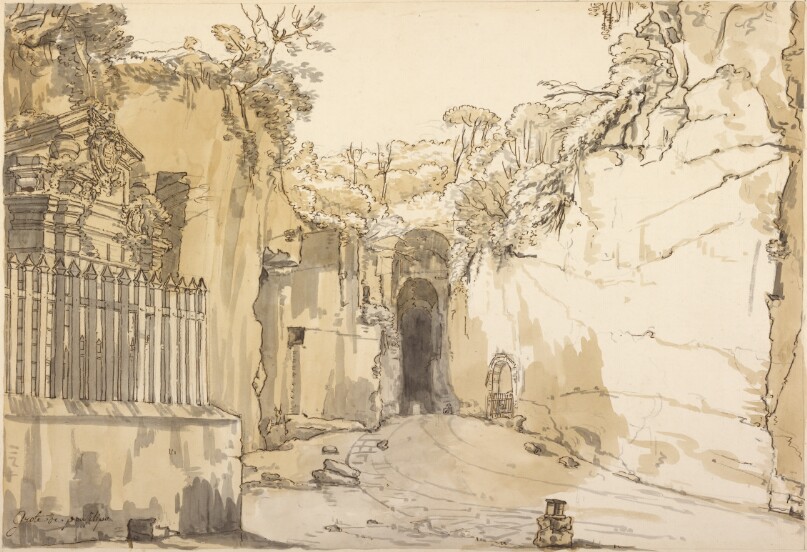
The Entrance to the Grotto at Posillipo
Creator
Claude-Joseph VernetFrench Artist · 1714–1789
All works by this person →> He has stolen Nature's secret; whatever she produces, Vernet can recreate. > >--Denis Diderot, reviewing the Salon of 1763 A coach painter's son, Claude-Joseph Vernet first studied with his father, then with a painter in Aix-en-Provence. Supported by some of the region's art patrons, the young artist went to Rome in 1734, where he studied the works of Claude Lorrain and trained under a follower
More on Getty ULAN- Date
- about 1750
- Medium
- Pen and brown ink, with brown and gray wash, over black chalk
- Culture
- French
- Department
- Drawings
- Institution
- Getty Museum
- Object ID
- 960d8931-6c4c-423d-8f1d-d14c3e78d775
From the Getty Museum record
>Once you are in position you must take as the subject of your drawing or painting what can be encompassed in one glance, without moving or turning your head... You must copy it as exactly as possible, both in form and in color, and do not think you can do better by adding or subtracting. So wrote Claude-Joseph Vernet in a letter describing his ideas on landscape painting in 1765. In this drawing, produced outside as an exercise in sketching, Vernet followed his own advice. Focusing on the combination of sunlit rock, overgrown trees, and undergrowth that formed the entrance to the murky tunnel opening at the back, he concentrated on a factual representation of the scene, including the fine roadside tomb on the left. The small chink of light in the midst of the shadow marks the other end of the tunnel, giving a sense of its length and breadth. Known as the Grotto at Posilipo, this tunnel, cut by the Romans to link Naples with the town of Pozzuoli, was a famous tourist attraction in the 1700s. Visitors admired it both for the drama of its tall, dark, and narrow space and as a feat of Roman engineering.
The authoritative record is held by Getty Museum. LinkedCulture surfaces this object and its connections; it does not alter institutional metadata.
Get printable QR codesHide QR codes
Open QR codes for this object page and the museum record. They stay collapsed until needed.
Related across collections
Semantically similar works from Getty Museum and other institutions.