Getty Museum
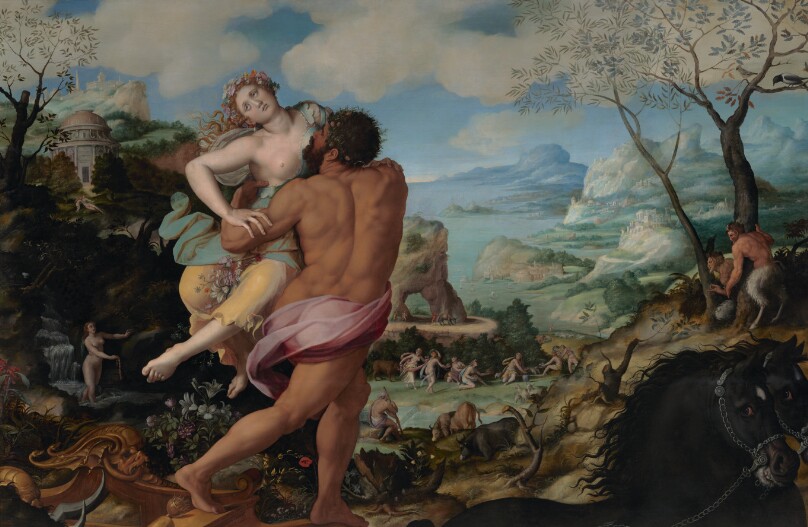
The Abduction of Proserpine
Creator
Alessandro AlloriItalian Artist · 1535–1607
All works by this person →Alessandro Allori was one of the most prolific and active painters in late sixteenth-century Florence. His father, a sword maker, died when Allori was five, and the painter Agnolo Bronzino was made guardian of the family. Allori incorporated Bronzino's name into his own, as seen in the inscription on one of his paintings: *Alexander Alorius Angeli Bronzini Alumnus Faciebat A D MDLXX* (Allessandro
More on Getty ULAN- Date
- 1570
- Medium
- Oil on panel
- Culture
- Italian
- Department
- Paintings
- Institution
- Getty Museum
- Object ID
- 97500915-3950-4841-afe5-cc39b87cc7b5
From the Getty Museum record
Pluto, god of the Underworld, seizes Proserpine, daughter of Roman goddess of agriculture and fertility, Ceres, and prepares to return with her to his kingdom on a chariot drawn by black horses. According to Ovid's *Metamorphoses*, Proserpine was forced to live in the underworld for four months of every year; her departure from earth marked the advent of winter, and her return brought about spring and summer. The muscular, marble-like figures illustrate the influence of Michelangelo (1475–1564) on the younger Florentine artist, while their complex, twisted poses and bright, saturated colors reflect that of his adoptive father and master, Bronzino (1503–1572). Painted on a large wood panel, this work was conceived as part of a series of three monumental mythological scenes painted between 1570 and 1572 as decoration for Alamanno Salviati’s villa at Ponte alla Badia near Florence. The accompanying scenes, depicting *Aeneas* and *Anchises and Narcissus*, are today located in the residence of the Turkish Ambassador, Washington, D.C.
The authoritative record is held by Getty Museum. LinkedCulture surfaces this object and its connections; it does not alter institutional metadata.
Get printable QR codesHide QR codes
Open QR codes for this object page and the museum record. They stay collapsed until needed.
Related across collections
Semantically similar works from Getty Museum and other institutions.