Getty Museum
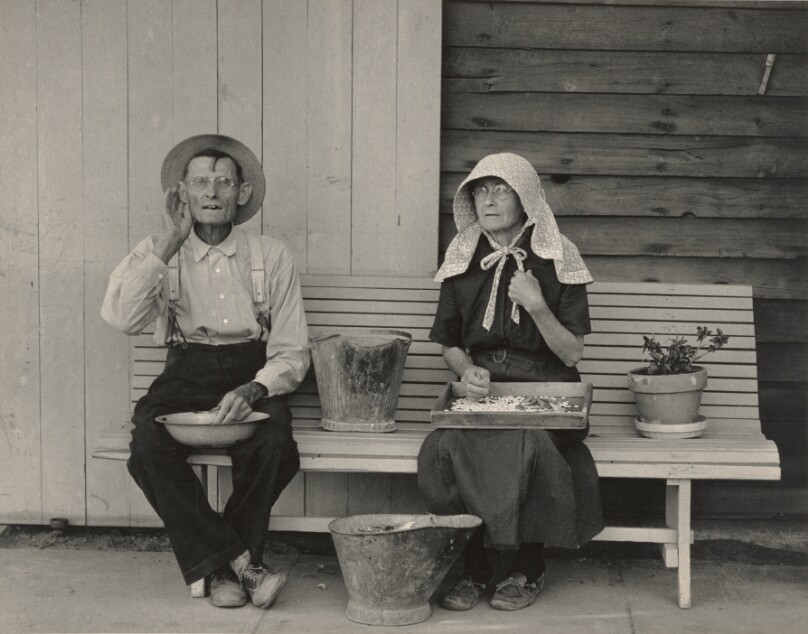
Amana Society Village, Iowa
Creator
Dorothea LangeAmerican Photographer · 1895–1965
All works by this person →Born Dorothea Nutzhorn in Hoboken, New Jersey, to first-generation German Americans, Dorothea Lange was stricken at age seven with polio, which left her right leg and foot disfigured. Her father abandoned the family when she was twelve. After high school, she apprenticed with portrait photographer Arnold Genthe in Manhattan and studied with Clarence H. White at Columbia University’s Teacher’s Coll
More on Getty ULAN- Date
- negative 1941; print about 1960s
- Medium
- Gelatin silver print
- Culture
- American
- Department
- Photographs
- Institution
- Getty Museum
- Object ID
- 9a06388d-7072-413f-afc5-3a4558451f27
From the Getty Museum record
> After years of completing assignments issued from Washington, D. C., Dorothea Lange was anxious to have time to herself, working in the field and in the darkroom at her own pace. To this end she applied for a yearlong Guggenheim Fellowship in 1940 with this simple statement of purpose: "To photograph people in selected rural American communities. The theme of the project is the relation of man to earth and man to man, and the forces of stability and change in communities of contrasting types." She and her second husband, Paul Schuster Taylor, whose academic pursuit continued to be the study of agricultural labor, planned a trip to Iowa, South Dakota, and Nebraska. They hoped to visit various cooperative communities settled by nineteenth-century immigrants, such as the Amana Society villages in eastern Iowa. > > Taylor, who grew up on the other side of the state, in Sioux City, may have suggested Iowa as a destination. He described the history of this group in a 1942 article for the Department of Agriculture: "About 1855, a German Protestant sect, the Community of True Inspiration, bought 26,000 acres of good land in eastern Iowa. The grandchildren, great-grandchildren and even a few of the children are there today. Their forefathers pooled their goods when they went to the frontier before the Civil War and founded the seven villages of Amana. Their religion didn't command that, like early Christians, they should have all things in common, but it permitted it." Taylor goes on to say that in 1932 the community "voted out communism in the form they had known it." The enormous farm was, however, still run as one unit by society members, such as this couple, who are shelling peas together in what appears to be a photographic variation on Wood's signature printing, [*American Gothic*](http://www.artic.edu/aic/collections/artwork/6565) (1930). Judith Keller, *Dorothea Lange,* In Focus: Photographs from the J. Paul Getty Museum (Los Angeles: J. Paul Getty Museum, 2002), 48. © 2002 J. Paul Getty Trust.
The authoritative record is held by Getty Museum. LinkedCulture surfaces this object and its connections; it does not alter institutional metadata.
Get printable QR codesHide QR codes
Open QR codes for this object page and the museum record. They stay collapsed until needed.
Related across collections
Semantically similar works from Getty Museum and other institutions.