Getty Museum
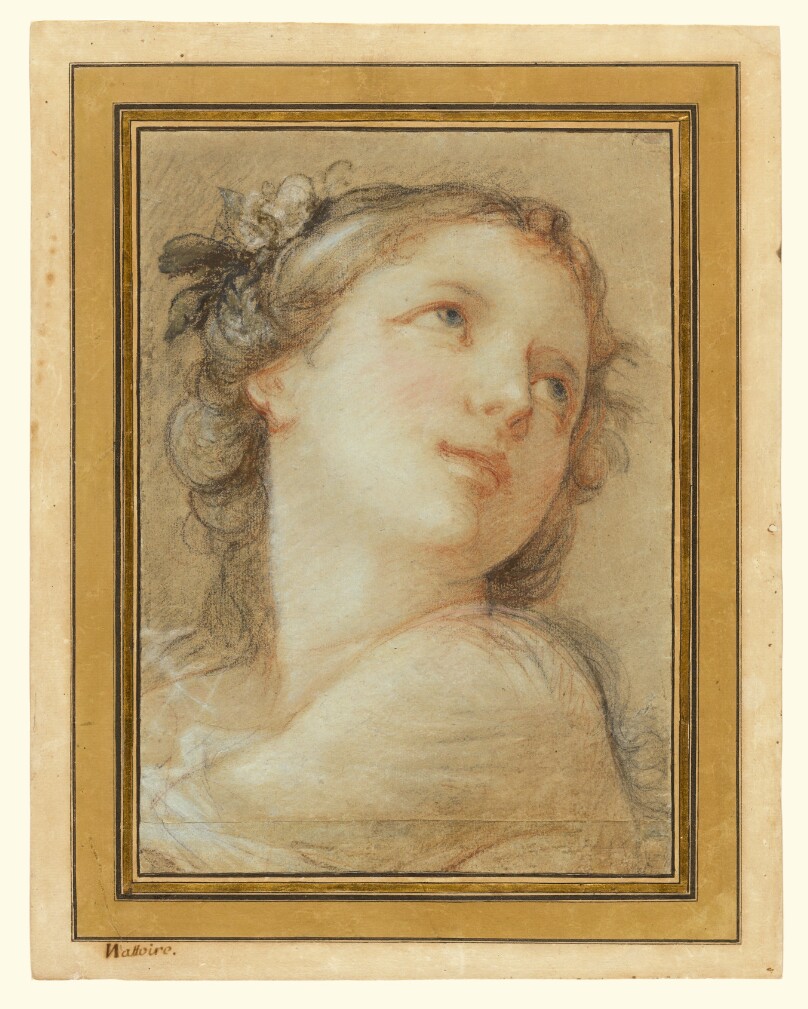
Head of a bacchante
Creator
Charles-Joseph NatoireFrench Artist · 1700–1777
All works by this person →Initially trained by his father, a sculptor, Charles-Joseph Natoire moved to Paris at the age of seventeen to apprentice with the painter Louis Galloche. He then studied with Francois Le Moyne, from whom he inherited a taste for the female nude. Natoire's first known painting, *Manoah Offering a Sacrifice to the Lord,* won him the coveted Prix de Rome in 1721. While at the Académie de France in Ro
More on Getty ULAN- Date
- 1741
- Medium
- Black and red chalk, heightened with white chalk and blue and pink pastels, on blue-gray paper
- Culture
- French
- Department
- Drawings
- Institution
- Getty Museum
- Object ID
- 9a6d8f63-57dc-497f-a0bd-c896bd0a3a29
From the Getty Museum record
Charles-Joseph Natoire, who was often praised for his sensual depiction of the female nude, skillfully evoked the qualities of flesh in the full lips, long neck, rounded shoulder, and smooth, rosy cheeks of this head study. Natoire used meticulous layers of chalk and pastel for his subject's complexion, and long, loose chalk strokes for her hair. He made this drawing as a study for the *Entry of Marc Antony into Ephesus* , the first of three designs he created for a tapestry series to be woven at the Gobelins Tapestry Manufactory. In the completed design, this figure dances in the foreground, holding a tambourine-like musical instrument in her outstretched arms. Her upward gaze is directed to Marc Antony, who stands behind her, high on his chariot. Natoire's designs failed to please the Marquis de Marigny, Louis XV's director-general of the *Bâtiments du Roi* , and only one tapestry from the series was ever produced.
The authoritative record is held by Getty Museum. LinkedCulture surfaces this object and its connections; it does not alter institutional metadata.
Get printable QR codesHide QR codes
Open QR codes for this object page and the museum record. They stay collapsed until needed.
Related across collections
Semantically similar works from Getty Museum and other institutions.