Getty Museum
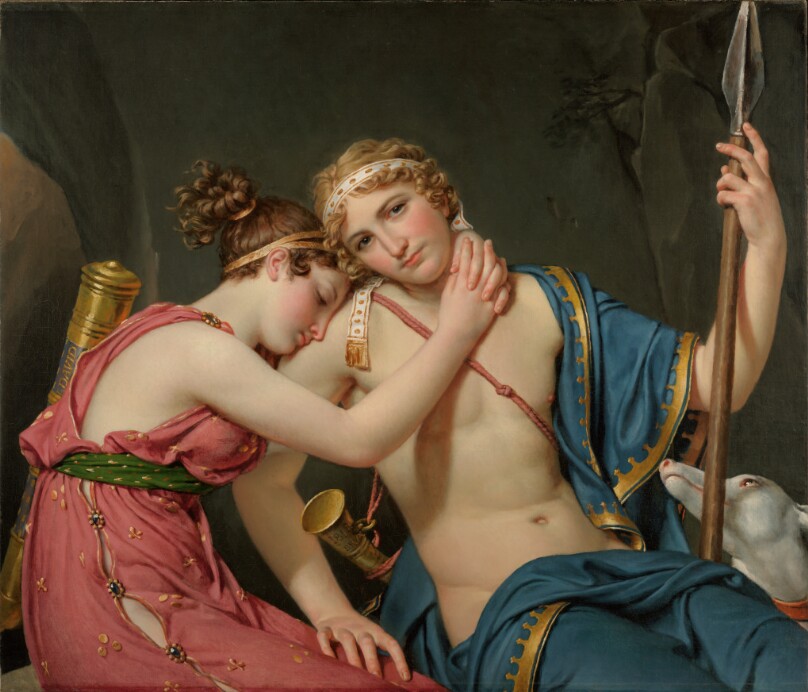
The Farewell of Telemachus and Eucharis
Creator
Jacques-Louis DavidFrench Artist · 1748–1825
All works by this person →Jacques-Louis David studied drawing and the literary classics before being accepted into the Académie Royale at the young age of eighteen. After eight years of struggle, he finally won the coveted Prix de Rome. Visits to ruins, exposure to Neoclassical doctrines, and study of Nicolas Poussin's classicism encouraged him to adopt a style and subject matter derived from antiquity. Returning in Paris
More on Getty ULAN- Date
- 1818
- Medium
- Oil on canvas
- Culture
- French
- Department
- Paintings
- Institution
- Getty Museum
- Object ID
- 9a9c0a0c-bcbc-46bc-8a7a-d1dcb06085ed
From the Getty Museum record
Fixing the viewer with a dreamy gaze, the fair-haired Telemachus grasps Eucharis's thigh with his right hand while holding his spear upright with the other. In the 1699 French novel *Les Aventures de Télémaque*, loosely based on characters from the *Odyssey*, the author Fénelon describes how Telemachus, the son of Odysseus, fell passionately in love with the beautiful nymph Eucharis. His duty as a son, however, required that he end their romance and depart in search of his missing father. The ill-fated lovers say farewell in a grotto on Calypso's island. Facing towards us, Telemachus's blue tunic falls open to reveal his naked torso. Eucharis, seen in profile, encircles Telemachus's neck and gently rests her head upon his shoulder in resignation. In this way, Jacques-Louis David contrasts masculine rectitude with female emotion. David painted *The Farewell of Telemachus and Eucharis* during his exile in Brussels. The use of saturated reds and blues contrasted with flesh tones and combined with a clarity of line and form typifies the Neoclassical style, which is characteristic of David's late history paintings.
The authoritative record is held by Getty Museum. LinkedCulture surfaces this object and its connections; it does not alter institutional metadata.
Get printable QR codesHide QR codes
Open QR codes for this object page and the museum record. They stay collapsed until needed.
Related across collections
Semantically similar works from Getty Museum and other institutions.