Getty Museum
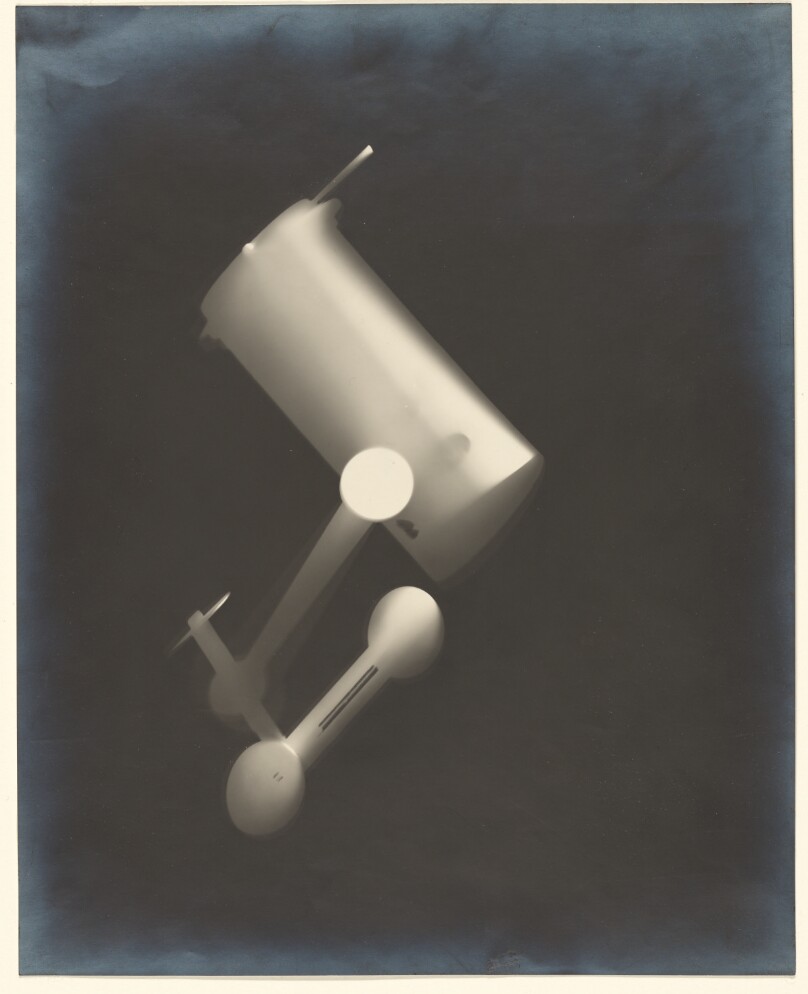
Fotogramm (negativ)
Creator
László Moholy-NagyAmerican Photographer · 1895–1946
All works by this person →> The reality of our century is technology: the invention, construction and maintenance of machines. To be a user of machines is to be of the spirit of this century. Machines have replaced the transcendental spiritualism of past eras. > > --László Moholy-Nagy > > Perhaps more than any other artist in the Getty Museum collection, László Moholy-Nagy would have delighted in the presentation of his im
More on Getty ULAN- Date
- 1928
- Medium
- Gelatin silver print
- Culture
- American
- Department
- Photographs
- Institution
- Getty Museum
- Object ID
- 9ad583ee-5cd8-4123-aae5-8ac4bf980cda
From the Getty Museum record
> For a period of time beginning around 1927, László Moholy-Nagy placed less emphasis on painting and instead concentrated his efforts on photography and writing. In his 1929 article “Fotogramm und Grenzgebiete” (Photogram and frontier zones), published in the Dutch journal *i10,* he declares that the central issue of future visual creation will be “creation with direct light,” relegating traditional “manual pigment painting” to a historical and educational role. With photography the artist could draw with light, rather than pigment, on the tabula rasa of photosensitive paper, as described in his 1928 essay “Fotografie ist Lichtgestaltung” (Photography is creation with light). This joining of science and art is particularly magical in this composition, in which the floating forms radiate against the velvety darkness. > > Katherine Ware, *László Moholy-Nagy*, In Focus: Photographs from the J. Paul Getty Museum (Los Angeles: J. Paul Getty Museum, 1995), 68. © 1995 The J. Paul Getty Museum.
The authoritative record is held by Getty Museum. LinkedCulture surfaces this object and its connections; it does not alter institutional metadata.
Get printable QR codesHide QR codes
Open QR codes for this object page and the museum record. They stay collapsed until needed.
Related across collections
Semantically similar works from Getty Museum and other institutions.