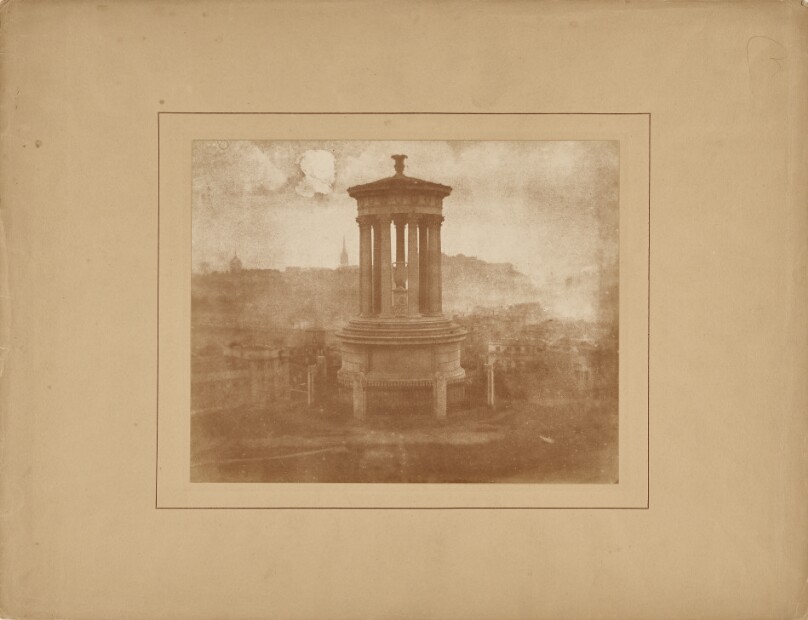
[Calton Hill, the Dugald Stewart Monument]

Getty Museum

[Calton Hill, the Dugald Stewart Monument]

Hill & Adamson

Object Description · Getty Museum

> Rock House, situated on Calton Hill overlooking an area of Edinburgh known as the New Town. In the mid-1700s plans were drawn up to develop the land to the north, because the city had long outgrown its original medieval boundaries. In contrast to the Old Town's overcrowded layout, the New Town was organized around a spacious grid designed in 1767 by the young architect James Craig (1744-95). > > Edinburgh became known as the "Athens of the North" during the early years of the nineteenth century due to the Neoclassical designs of the architect William Henry Playfair (1789-1857), who built two memorials on Calton Hill. The National Monument, the largest structure on the hill, commemorates the Napoleonic Wars. A reproduction of the Parthenon, it was begun in 1822 and remains unfinished. This calotype shows the second memorial, a smaller, circular temple dedicated to the great Scottish philosopher Dugald Stewart (1753-1828), who was a leading figure during the Enlightenment. > > In 1792 Stewart published *Elements of the Philosophy of the Human Mind*, a treatise that begins with a discussion on sight. Stewart, like the philosopher David Hume (1711-76) before him, was particularly interested in perception as a means of understanding the world, believing that one could not focus on everything but was limited to specific details. A visual illustration of this discourse was found in portrait paintings by Allan Ramsay (1713-84) and Sir Henry Raeburn (1756-1823), where the focus was on the face and less on the surroundings, which were often rendered in cursory brush strokes. Such associations between philosophy and art were quite profound in Scotland. When photography was introduced, its relationship to these sight and perception ideas was surely comprehensible to many. Thus the calotypes of Hill and Adamson (David Octavius Hill [1802-70] and Robert Adamson (1821-48]) not only continued in the tradition of portraiture, they also touched on the philosophical concerns of the late eighteenth century. > > Anne M. Lyden. *Hill and Adamson*, In Focus: Photographs from the J. Paul Getty Museum (Los Angeles: J. Paul Getty Museum, 1999), 44. ©1999, J. Paul Getty Museum. For more information about the places Hill and Adamson photographed see: [“Hill and Adamson: Place”](https://www.youtube.com/watch?v=sl_MF40BGDk).

Getty Museum’s catalogue record

produced_by.carried_out_by[0].id
https://data.getty.edu/museum/collection/group/c058dcff-0a95-4728-b2c2-8075eae6383a
Artist/Maker
Hill & Adamson
subject_of[Homepage].id
https://www.getty.edu/art/collection/object/1044PK
Date
1843–1847
Medium
Salted paper print from a paper negative
Object Type
Print

Taken from LinkedCulture’s stored copy of Getty Museum’s record. A fresh capture of the museum’s own record has not been made for this object yet.

The authoritative record is held by Getty Museum. LinkedCulture surfaces this object and its connections; it does not alter institutional metadata. The fields above are the museum’s, under its own labels. LinkedCulture’s derived fields are listed separately below and marked as ours.

Get printable QR codes

Open QR codes for this object page and the museum record. They stay collapsed until needed.

Open this page QR destination: https://linkedculture.org/q/q1.Ci-MjoeR4Js_AsN9.h2GokuHScSYdOTv5LYj7BfVGdFg6qZEXiSspc9QH7MMSGB4DYuHATmy8AZco414ZpK42cv3gEKqM7-HjeOYSjBRSIiLw9EhWzdzUNHYvAbT_G6pH0vJj5rjboR-m53x4XUZE7unaFAeebow29PiO_Q7JAg3fmM2P0FLru2I1qOcL7nxmcnUNuM5RBZpqAx-wExXkkD-GFhZCtBjtFHA0y3xO1HroMdJGXIAowOuX3uxjfk65lrHPiVz0fWk_OwhgzpJpu0wjh2qYRi_sXjoDPYe4bVAp4Gpj8MxZPm0NZj4nFC8Llsuz0e-cq1pe-9dXjoNMSlP1ODeQKlTWnZqs99fLrs5SGj98w6coL12KZ6Ly-h_N-VUsOwOe5b4iBvyduzPaWsMgilpYm2NLkKnOSee at Getty Museum QR destination: https://linkedculture.org/q/q1.e3bLG-jGq7eNQPw4.SrHPL18SR5gytCgfQPkCq5LiOyMBis_3tSAYw64ZSJwM-3Y9D_wN0AgNygp-oibGFDderLxXhBHF8vPDkyrfGuBjZKv9C0HfaLwsyMp8hEORwh_Uo_huPr7EHhDSH4oTIqpXquC2sRyr0xFwEMEIxLMfjSTfUYgugSJDDOr4I1sLmRv7kfIrccH2QPJpgFMSatgRUyuuE-aHxK9clSlmqWzE_0ENFJZJvc-m5HtMYDhR2ohrjc4hOcjMxCrOOjZZ_fBHAgEqCmwgGtFr4K6la9e0ABIWWZ5eE8rPpAWPQGD9huhyUkd5ItHjIx7-sxSK3hcAe6KxsY1v7FPxS0UvRkRoHsTnkMYRM-1ICqgwTH3jrnz5aazCa7pcNN0
Open this page
See at Getty Museum
How LinkedCulture maps this record

To search objects from different museums together, LinkedCulture reads each museum’s record into a common set of fields. The values below are LinkedCulture’s, under LinkedCulture’s names. They are not Getty Museum’s wording; the museum’s own record is shown above under its own labels.

Object ID
9d0d8a58-3817-4bf1-b924-c53a12826dea
Object Type
Print
  • Getty Museum field “Object Type” · copied as is
Creator
Hill & Adamson
  • Getty Museum field “Artist/Maker” · copied as is
Medium
Salted paper print from a paper negative
  • Getty Museum field “Medium” · copied as is
Department
Photographs
  • Getty Museum field “Department” · derived by LinkedCulture from the museum field · Getty's classification category is stored as department.
Credit Line
The J. Paul Getty Museum, Los Angeles
  • Getty Museum field “Standard Credit Line” · the first available of several museum fields
  • Getty Museum field “Source Credit Line” · the first available of several museum fields
Date
1843–1847
  • Getty Museum field “Date” · copied as is
Begin Year
1843
  • Getty Museum field “produced_by.timespan.begin_of_the_begin” · derived by LinkedCulture from the museum field
End Year
1847
  • Getty Museum field “produced_by.timespan.end_of_the_end” · derived by LinkedCulture from the museum field

The museum’s own record has not been captured for this object yet, so the museum fields shown above are limited to values LinkedCulture stored unchanged.

Related across collections

Semantically similar works from Getty Museum and other institutions.