Getty Museum
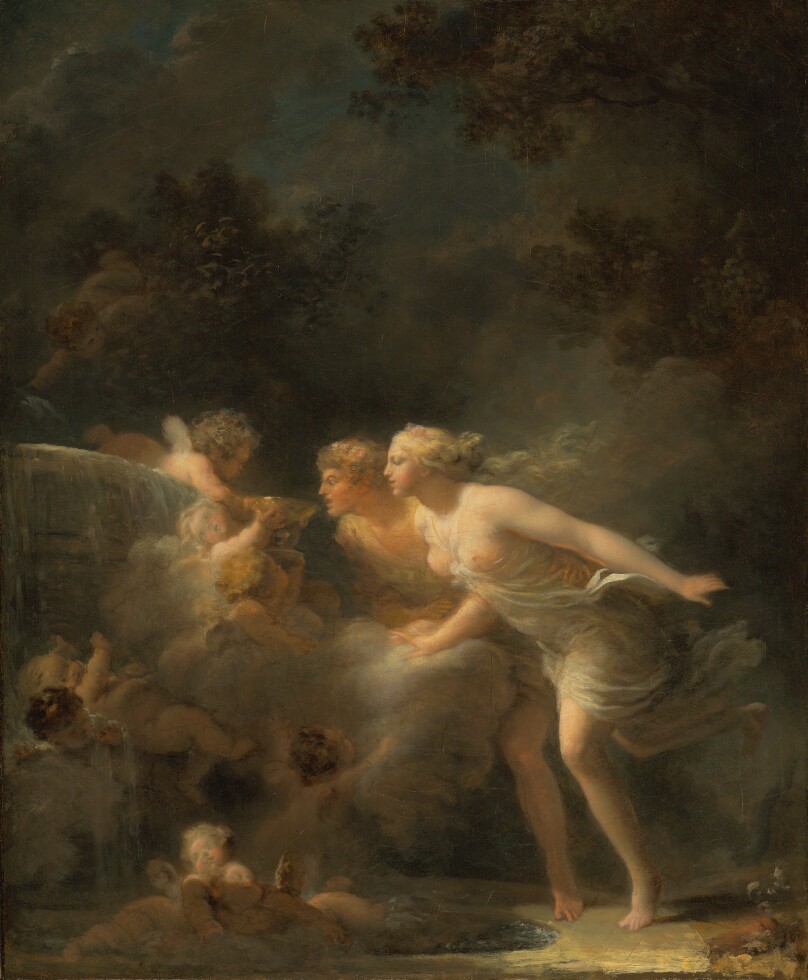
The Fountain of Love
Creator
Jean-Honoré FragonardFrench Artist · 1732–1806
All works by this person →Born in the small city of Grasse, Jean-Honoré Fragonard moved to Paris with his family in 1738. While still in his teens, he apprenticed to Jean-Baptiste-Siméon Chardin for just six months and then worked in François Boucher's studio. He won the Prix de Rome in 1752, then spent three preparatory years under Carle Vanloo before studying at the Académie de France in Rome from 1756 to 1761. Fragonard
More on Getty ULAN- Date
- about 1785
- Medium
- Oil on canvas
- Culture
- French
- Department
- Paintings
- Institution
- Getty Museum
- Object ID
- 9e64bb1b-5f7c-49f0-aff1-65f83908728e
From the Getty Museum record
In the midst of a verdant forest, a young man and woman eagerly rush forward, their feet just reaching the edge of a fountain's basin. Putti frolic in the fountain's waters and billowing spray, and one of them offers a cup of the magical liquid for the young lovers to drink. The story of the Garden of Love, an allegory of the nature and progress of love that has its origins in the poetry of classical antiquity and the Middle Ages, centers on this Fountain of Love. The fountain brings forth the water, into which Cupid dips his arrows or from which lovers drink and fall in love. In nearly every period, artists have painted this romantic motif. During the 1700s, artists came to treat the Fountain of Love almost as a genre subject, with lovers in contemporary dress flirting in a garden around a decorative fountain. With this version, Jean-Honoré Fragonard returned the allegory to its classical origins and imbued it with the thrilling rush of those first beguiling moments of love. The quintessential Rococo artist, Fragonard responded to the Neoclassical movement in an extremely inventive manner, adding a soft, steamy atmosphere to his cameo-like figures.
The authoritative record is held by Getty Museum. LinkedCulture surfaces this object and its connections; it does not alter institutional metadata.
Get printable QR codesHide QR codes
Open QR codes for this object page and the museum record. They stay collapsed until needed.
Related across collections
Semantically similar works from Getty Museum and other institutions.