Getty Museum
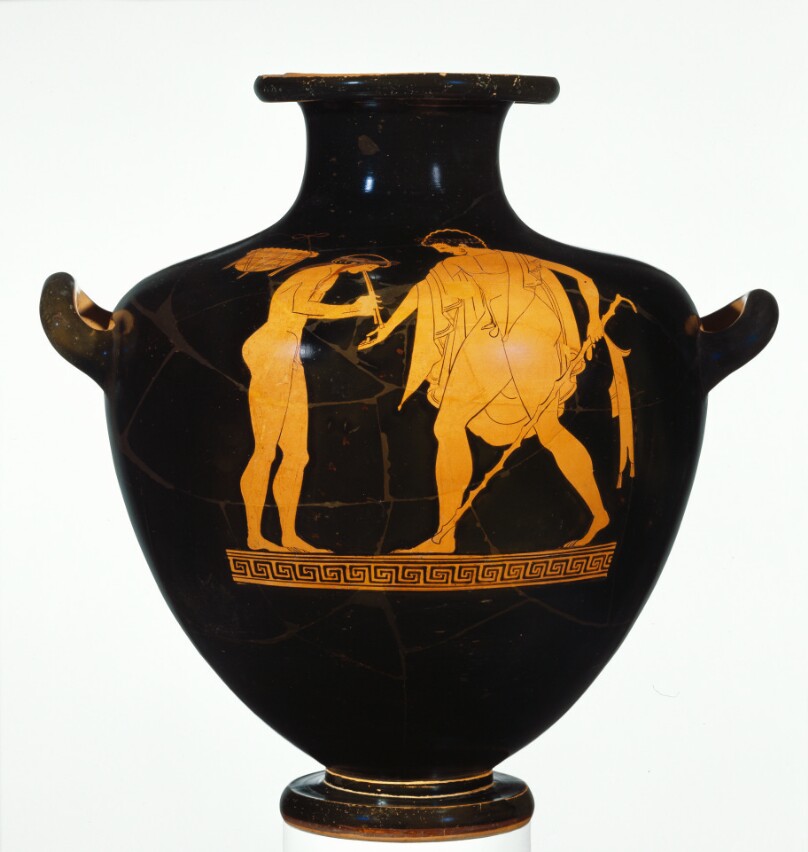
Attic Red-Figure Kalpis
Creator
Eucharides PainterPainter
All works by this person →By the early 400s B.C., most Athenian vase-painters had committed to either the black-figure or the newer red-figure technique of vase decoration. The Eucharides Painter was one of the few artists to leave a substantial group of vases in both techniques. Working in Athens in the years from about 500 to 470 B.C., the Eucharides Painter decorated a wide variety of vase shapes, from large kraters to
More on Getty ULAN- Date
- about 480 B.C.
- Medium
- Terracotta
- Culture
- Greek (Attic)
- Department
- Vessels
- Institution
- Getty Museum
- Object ID
- a3bbd552-fad6-4452-9696-bcd381965c10
From the Getty Museum record
A boy plays the double flutes for a young reveler on this Athenian red-figure kalpis. Several signs--the provision basket hanging on the wall, the wreath on the youth's head, and the boy's red ribbon--indicate that the action takes place at a symposion or aristocratic drinking party. The youth, who is shown as just old enough to grow a downy beard, holds a walking stick and the case for the boy's flute. He approaches the boy with a hand lowered toward his genitals, the standard gesture of young men courting boys. The celebration of desirable male youth was a key component in elite Athenian culture, and an inscription between the figures reads "Eucharides is beautiful." Eucharides would have been one of the handsome adolescents in Athens in the years around 480 B.C. A kalpis is a rounded variant form of a hydria or water vessel. Greeks always drank their wine mixed with water, and a vessel like this one could have held the water at a symposion. The decoration on the vessel foretold the pleasures of the evening.
The authoritative record is held by Getty Museum. LinkedCulture surfaces this object and its connections; it does not alter institutional metadata.
Get printable QR codesHide QR codes
Open QR codes for this object page and the museum record. They stay collapsed until needed.
Related across collections
Semantically similar works from Getty Museum and other institutions.