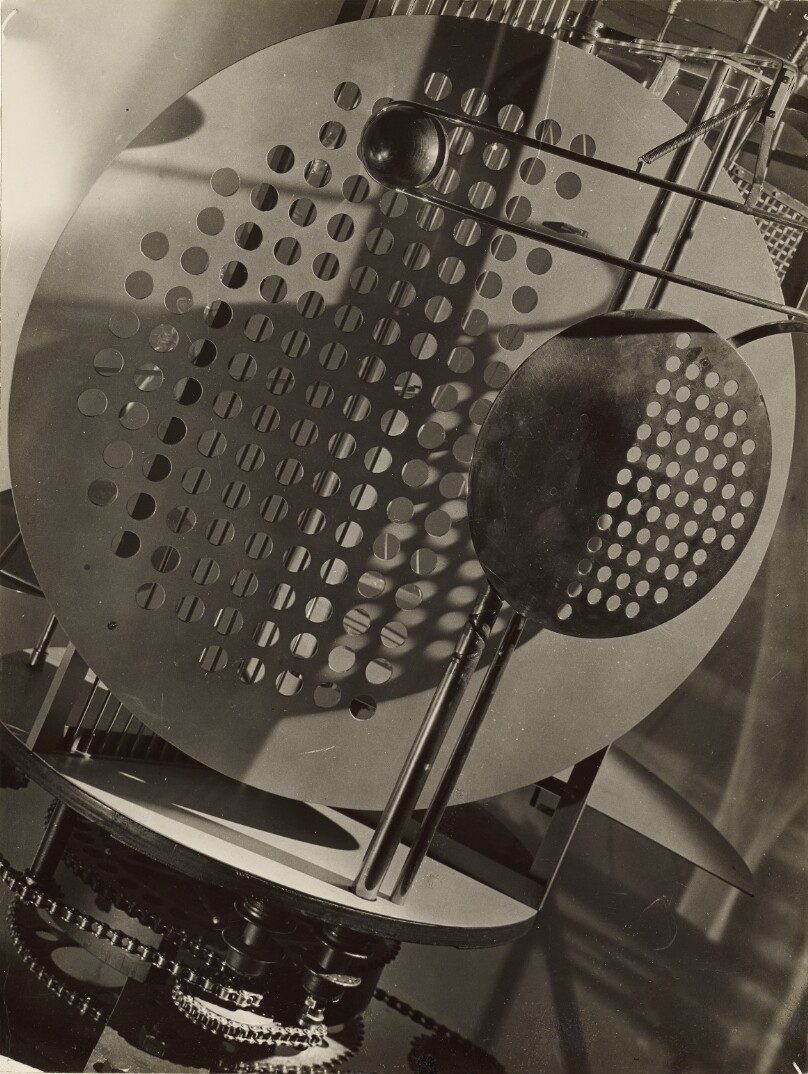
Das Lichtrequisit

Getty Museum

Das Lichtrequisit

Creator

László Moholy-Nagy

American Photographer · 1895–1946

All works by this person →
AuthorDesignerArtist

> The reality of our century is technology: the invention, construction and maintenance of machines. To be a user of machines is to be of the spirit of this century. Machines have replaced the transcendental spiritualism of past eras. > > --László Moholy-Nagy > > Perhaps more than any other artist in the Getty Museum collection, László Moholy-Nagy would have delighted in the presentation of his im

More on Getty ULAN

Object Description · Getty Museum

> The *Light-Space Modulator* is the most spectacular and complete realization of László Moholy-Nagy’s artistic philosophy. Machine parts and mechanical structures began to appear in his paintings after his emigration from Hungary, and they are also seen in the illustrations he selected for the 1922 *Buch neuer Künstler* (Book of new artists), which includes pictures of motorcars and bridges as well as painting and sculpture. Many contemporary artists incorporated references to machines and technology in their work, and some, like the Russian Constructivist Vladimir Tatlin, even designed plans for fantastic structures, such as the ambitious *Monument to the Third International*, a proposed architectural spiral of glass and steel with moving tiers and audiovisual broadcasts. ([Tatlin's Tower](https://en.wikipedia.org/wiki/Tatlin%27s_Tower))) > > In the *Light-Space Modulator*, Moholy-Nagy was able to create an actual working mechanism. Although he censured capitalism’s inhumane use of technology, he believed it could be harnessed to benefit mankind and that the artist had an important role in accomplishing this. Moholy had made preliminary sketches for kinetic sculptures as early as 1922 and referred to the idea for a light machine in his writings, but it was not until production was financed by an electric company in Berlin in 1930 that this device was built, with the assistance of an engineer and a metalsmith. It was featured at the Werkbund exhibition in Paris the same year, along with the short film *Light Display Black-White-Gray*, made by Moholy-Nagy to demonstrate and celebrate his new machine. > > The *Light-Space Modulator* is a Moholy-Nagy painting come to life: mobile perforated disks, a rotating glass spiral, and a sliding ball create the effect of photograms in motion. With its gleaming glass and metal surfaces, this piece (now in the collection of the [Busch-Reisinger Museum at Harvard University](https://www.harvardartmuseums.org/art/299819)) is not only a machine for creating light displays but also a sculptural object of beauty, photographed admiringly by its creator. (See also: [84.XP.912.3](http://www.getty.edu/art/collection/objects/45321/laszlo-moholy-nagy-das-lichtrequisit-american-1930/) and [84.XM.231.1](http://www.getty.edu/art/collection/objects/56284/laszlo-moholy-nagy-aus-dem-lichtspielfilm-schwarz-weiss-grau-american-1930/)) > > Katherine Ware, *László Moholy-Nagy*, In Focus: Photographs from the J. Paul Getty Museum (Los Angeles: J. Paul Getty Museum, 1995), 80 © 1995 The J. Paul Getty Museum.

Getty Museum’s catalogue record

produced_by.carried_out_by[0].id
https://data.getty.edu/museum/collection/person/bad14de1-7ef3-42b8-b6ca-f536812d9a68
Artist/Maker
László Moholy-Nagy
subject_of[Homepage].id
https://www.getty.edu/art/collection/object/1049W0
Date
1930
Medium
Gelatin silver print
Culture
American
Object Type
Print

Taken from LinkedCulture’s stored copy of Getty Museum’s record. A fresh capture of the museum’s own record has not been made for this object yet.

The authoritative record is held by Getty Museum. LinkedCulture surfaces this object and its connections; it does not alter institutional metadata. The fields above are the museum’s, under its own labels. LinkedCulture’s derived fields are listed separately below and marked as ours.

Get printable QR codes

Open QR codes for this object page and the museum record. They stay collapsed until needed.

Open this page QR destination: https://linkedculture.org/q/q1.j7AYkaR9ENez2oJb.M77BLZwpSxabxB869qkH_df3DkGZvOy5LMOS6MNXGC8LO2afgQdyh9tm-HRMbauVF8ak1eNX3stkYEFaY3znYJ7j5h90WK0SpOuvaNw7nIMFo3KQHv7UXWRuE4OGL9C7H2JkTNPa6v5_-p__kahG4J23XCRiL-W2SNyGFzI4F4W0vHxqecFD2PlRUqurSgywUQaM4-eS-xxrLnC69yU0sd2kbd9yu9X-__3Z7chmL1fcBDEmV_9vQvDNftmhaAz_6nZ0JcyKaDG2D9myRjDPsc4qD1zVrc73rB3VLYyh6Iq0EHcRHUaW8KslracxdM70VdOtjIwfCi6STs59onVvCIlW-5x1evSQhN0YNJufpOV7L72-ilSoYj330KU_CDlc1HNyiLKnu0-Lp_BTAXUtSee at Getty Museum QR destination: https://linkedculture.org/q/q1.CR2_zjZBrsO7_laN.dUx03q5tVpVTdVlyRijZ7JxxdnyppxAhY7XrRofi1XI0WDogry8kuSEh_V7V_AHEhCRZ7SLEj5autJc_nM-Oxo49Yp6wBHdwfcSg15fLEZ0yMG2RpafUY0S31dvmiPMyjyS1CRbFMWPDoGcXPnb6AmRLP42i_jeslOLW7ISPT8NbMkD8VVIP2NZcIgg6SSEdLVTMGylKlzExH6zCESNXNsuLj9mA6ENoekYFOAWMH_WJz6FKWMbVXx88wkcJlXfSc2-bUWw8aPj6ekQJsuMsruYEDccfHwZDTlDTGT6JLTTSQpLKRlavt6C8TvrTUF_baEFwvd-tGsfA9zom9lF7i6aHhDIeEa4H-s9Or6-2e0RmhRrGcyZH4z2y9aI
Open this page
See at Getty Museum
How LinkedCulture maps this record

To search objects from different museums together, LinkedCulture reads each museum’s record into a common set of fields. The values below are LinkedCulture’s, under LinkedCulture’s names. They are not Getty Museum’s wording; the museum’s own record is shown above under its own labels.

Object ID
a5310522-9b54-4497-b5f6-00448fbdbdf0
Object Type
Print
  • Getty Museum field “Object Type” · copied as is
Creator
László Moholy-Nagy
  • Getty Museum field “Artist/Maker” · copied as is
Culture
American
  • Getty Museum field “Culture” · copied as is
Medium
Gelatin silver print
  • Getty Museum field “Medium” · copied as is
Department
Photographs
  • Getty Museum field “Department” · derived by LinkedCulture from the museum field · Getty's classification category is stored as department.
Credit Line
The J. Paul Getty Museum, Los Angeles
  • Getty Museum field “Standard Credit Line” · the first available of several museum fields
  • Getty Museum field “Source Credit Line” · the first available of several museum fields
Date
1930
  • Getty Museum field “Date” · copied as is
Begin Year
1930
  • Getty Museum field “produced_by.timespan.begin_of_the_begin” · derived by LinkedCulture from the museum field
End Year
1930
  • Getty Museum field “produced_by.timespan.end_of_the_end” · derived by LinkedCulture from the museum field

The museum’s own record has not been captured for this object yet, so the museum fields shown above are limited to values LinkedCulture stored unchanged.

Related across collections

Semantically similar works from Getty Museum and other institutions.