Getty Museum
Commode
Creator
Joseph BaumhauerFrench Artist · 1772–1772
All works by this person →Nothing is known about Joseph Baumhauer's childhood and training in Germany before his arrival in Paris in the 1740s. His marriage to the daughter of a French furniture-maker probably allowed him to establish himself in Paris at a time when established French cabinetmakers vociferously opposed immigrant craftsmen arriving from Germany and other countries. About 1749 Baumhauer was made a *marchand-
More on Getty ULAN- Date
- early to mid-1750s
- Medium
- White oak veneered with ebony and a wood possibly identified as servicetree, set with panels of Japanese lacquer on Japanese arborvitae, and painted with European lacquer; drawers of white oak; brass and iron hardware and lock; gilt-bronze mounts; campan mélange vert marble top
- Culture
- French (Paris)
- Department
- Decorative Arts
- Institution
- Getty Museum
- Object ID
- a7dbe692-b6a4-46e3-b237-372409d963cb
From the Getty Museum record
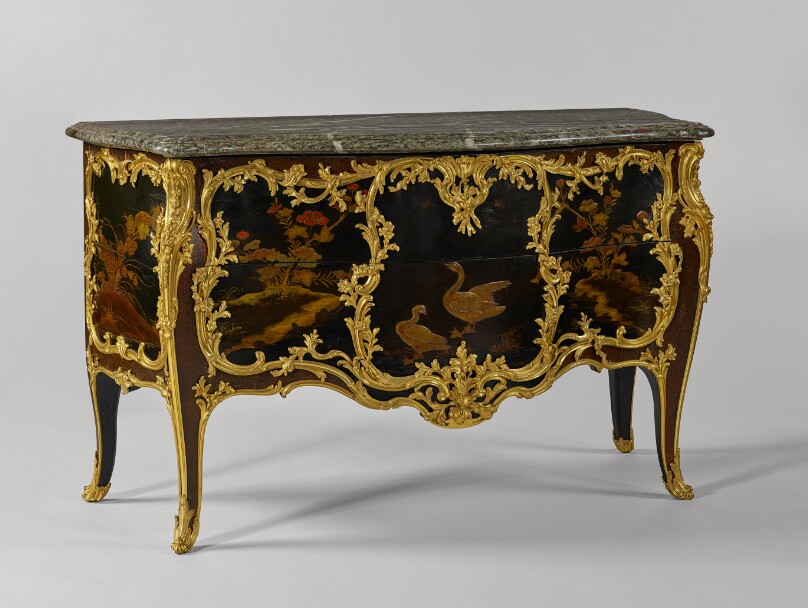
Every part of this commode is of the highest quality. The front and sides are set with panels of Japanese lacquer that were removed from an imported pair of cabinets. Delicately chased meandering gilt-bronze mounts hide the seams of the panels, and French imitation of Japanese *nashiji*, an orange-toned lacquer sprinkled with gold, covers the remaining surfaces. Even the thick marble top is carved both above and below its rim, an unusual refinement. This commode exemplifies the European passion for objects from East Asia and the Parisian taste for transforming these imported goods into quintessentially French wares. While its form is strictly French, the panels of Japanese lacquer are the focus of the design. In this case panels of Japanese lacquer of different sizes have been used by French craftsman to create a symmetrical composition out of panels that were originally asymmetrical. French craftsmen may have even painted on small details such as some flying insects and extraneous tufts of grass to the front panels, possibly to hide small areas of surface damage or perhaps to fill some empty sections of the original Japanese composition. Although the commode is not stamped with the name of a cabinetmaker, it is attributed to the cabinetmaker Joseph Baumhauer because it resembles other works stamped with his name. Two paper trade labels, pasted above and below the carcass, identify the *marchand-mercier* François Darnault (or his son François Charles), a dealer who sold luxury goods in his Paris shop, *Au Roy d'Espagne*, as the source of this commode.
The authoritative record is held by Getty Museum. LinkedCulture surfaces this object and its connections; it does not alter institutional metadata.
Get printable QR codesHide QR codes
Open QR codes for this object page and the museum record. They stay collapsed until needed.
Related across collections
Semantically similar works from Getty Museum and other institutions.