Getty Museum
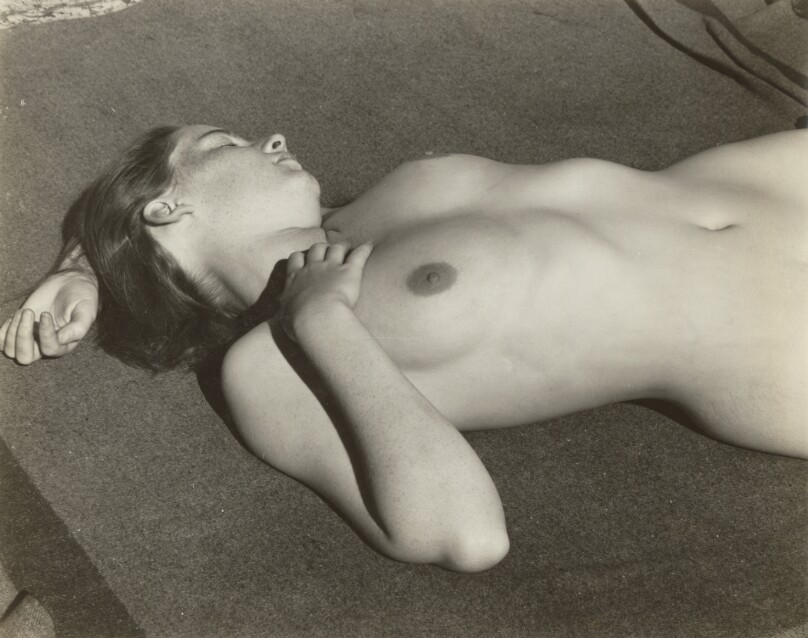
Sleeping Girl
Creator
Edward WestonAmerican Photographer · 1886–1958
All works by this person →> To clearly express my feeling for life with photographic beauty, present objectively the texture, rhythm, form in nature, without subterfuge or evasion in technique or spirit, to record the quintessence of the object or element before my lens, rather than an interpretation, a superficial phase, or passing mood--this is my way in photography. It is not an easy way. > > --Edward Weston In the spri
More on Getty ULAN- Date
- negative 1935; print about 1953
- Medium
- Gelatin silver print
- Culture
- American
- Department
- Photographs
- Institution
- Getty Museum
- Object ID
- a81f1d09-f21b-49a7-b358-1f185a0a152e
From the Getty Museum record
> The nude was a subject to which Edward Weston returned time and time again throughout his career, from the pictures of his first wife, Flora Chandler (1879-1965), in 1909 (see [86.XM.719.13](http://www.getty.edu/art/collection/objects/54992/edward-weston-nude-flora-chandler-weston-american-negative-1909-print-1910/)) to those of his second wife, Charis Wilson (1914-2009), in the 1930s (see [84.XM.1381.1](http://www.getty.edu/art/collection/objects/48248/edward-weston-nude-charis-wilson-american-1936/), [84.XM.860.2](http://www.getty.edu/art/collection/objects/45222/edward-weston-nude-charis-wilson-american-1934/), [85.XM.452.17](http://www.getty.edu/art/collection/objects/103179/edward-weston-charis-wilson-american-1934/), and [85.XM.452.8](http://www.getty.edu/art/collection/objects/103170/edward-weston-charis-wilson-american-1935/)). Despite the prominence of this theme in his oeuvre, it was little studied during his lifetime. Writer and photo critic Nancy Newhall (1908-1974) set out in 1951 to draw more attention to this important side of his work, writing an article that was published in Modern Photography in 1952. Shortly thereafter, Weston's son Brett (1911-1993) and studio assistant, Dody Warren (1923-2012), proposed a book on the topic. Newhall put together a maquette (see 85.XM.452) in about 1953, using an amplified version of her original article along with thirty-nine of fifty-two prints of nudes and nudelike forms that Weston sent her (including: [85.XM.452.4](http://www.getty.edu/art/collection/objects/103166/edward-weston-bertha-wardell-glendale-american-1927/), [85.XM.452.17](http://www.getty.edu/art/collection/objects/103179/edward-weston-charis-wilson-american-1934/), and [85.XM.452.25](http://www.getty.edu/art/collection/objects/103187/edward-weston-cypress-point-lobos-american-1944/)). > > One of the guiding visual principles of the proposed book was its juxtaposition of these nudelike forms, such as shells, dunes, and kelp, with pictures of unclothed figures that had a similar approach to form, line, and composition. For example, a picture of dry kelp and rocks (see [85.XM.452.13](http://www.getty.edu/art/collection/objects/103175/edward-weston-dry-kelp-point-lobos-american-1934/)) appeared together with this nude study of Wilson on a two-page spread. The idea for these pairings surely arose from Weston's own statements in the 1930s (in conjunction with his Delphic Studios exhibition in New York City) about the relationship among natural forms: "Life is a coherent whole: rocks, clouds, trees, shells, torsos, smokestacks, peppers are interrelated, interdependent parts of the whole. Rhythms from one become symbols of all." When the maquette was made, the photographer had long since diverged from the philosophies he had espoused in the 1930s, and his last negative had been exposed in 1948. But he was nonetheless excited to see the book project develop. He approved of Newhall's writing on his work and certainly needed the money a publication could deliver. The maquette, however, was not well received. The images proved too controversial for the era's puritanical sensibilities, and the project never found a publisher. > > Brett Abbott. *Edward Weston*, In Focus: Photographs from the J. Paul Getty Museum (Los Angeles: J. Paul Getty Museum, 2005), 90. ©2005, J. Paul Getty Trust.
The authoritative record is held by Getty Museum. LinkedCulture surfaces this object and its connections; it does not alter institutional metadata.
Get printable QR codesHide QR codes
Open QR codes for this object page and the museum record. They stay collapsed until needed.
Related across collections
Semantically similar works from Getty Museum and other institutions.