Getty Museum
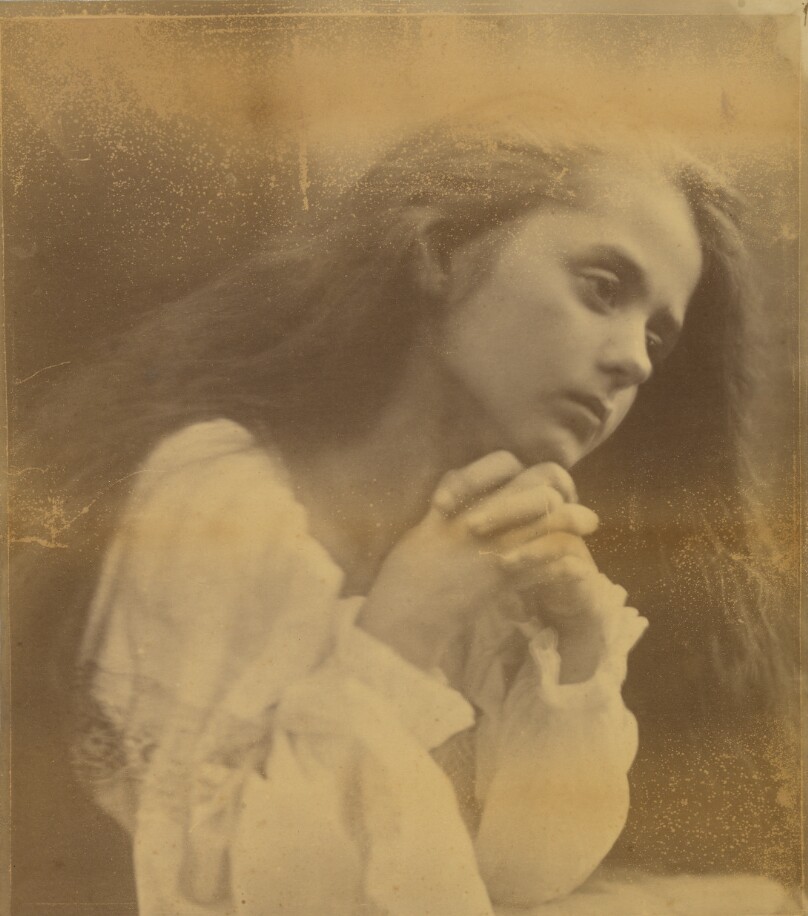
Young Girl Praying
Creator
Julia Margaret CameronBritish Photographer · 1815–1879
All works by this person →After receiving a camera as a gift, Julia Margaret Cameron began her career in photography at the age of forty-eight. She produced the majority of her work from her home at Freshwater on the Isle of Wight. By the coercive force of her eccentric personality, she enlisted everyone around her as models, from family members to domestic servants and local residents. The wife of a retired jurist, Camero
More on Getty ULAN- Date
- 1866
- Medium
- Albumen silver print
- Culture
- British
- Department
- Photographs
- Institution
- Getty Museum
- Object ID
- a842d58c-00eb-43e2-ba18-dbfb25065f81
From the Getty Museum record
> In January 1866 Julia Margaret Cameron wrote William Michael Rossetti and remarked that “for the *first* time in 26 years I am left without a child under my roof—but they are all doing well and struggling to improve and I must not grudge the sacrifice of their sweet society.” The absence of her cherished children spurred Cameron on to new endeavors in the art of photography; early in 1866 she moved into a highly creative period with the camera. > > Cameron’s charming study of a young girl (Florence Anson, 1860-1946) at prayer suggests the new direction that her work was to take. She began to move in closer to the subject and to create likenesses that were strikingly individuated. In this portrait, little more than the angelic face and abundant mane of hair of the sitter is in focus. Anson's locks, elegantly pushed over her shoulder, and the flowing blouse contribute opposite tonal values and serve primarily as formal complements to her visage. > > With certain negatives Cameron had great difficulties eliminating the bubbles, spots, and similar flaws, and more often than not these imperfections appear in the prints. The deterioration evident in bands throughout the upper, middle, and lower portions of this image is largely the result of toxic framing materials and poor original custodianship. The oxidation and fading around the edges that occurs in many of Cameron’s photographs can often be attributed to the vulnerability of the albumen print, the instability of which is accelerated by insufficient washing and toning. For Cameron, aesthetic effect and spiritual feeling were more important than considerations of technical prowess. As her son Henry Herschel Hay commented, “What was looked for by her was to produce an artistic result, no matter by what means. She always acted according to her instinct. > > Julian Cox. *Julia Margaret Cameron*, In Focus: From the J. Paul Getty Museum (Los Angeles: J. Paul Getty Museum, 1996), 50. ©1996 The J. Paul Getty Museum.
The authoritative record is held by Getty Museum. LinkedCulture surfaces this object and its connections; it does not alter institutional metadata.
Get printable QR codesHide QR codes
Open QR codes for this object page and the museum record. They stay collapsed until needed.
Related across collections
Semantically similar works from Getty Museum and other institutions.