Getty Museum
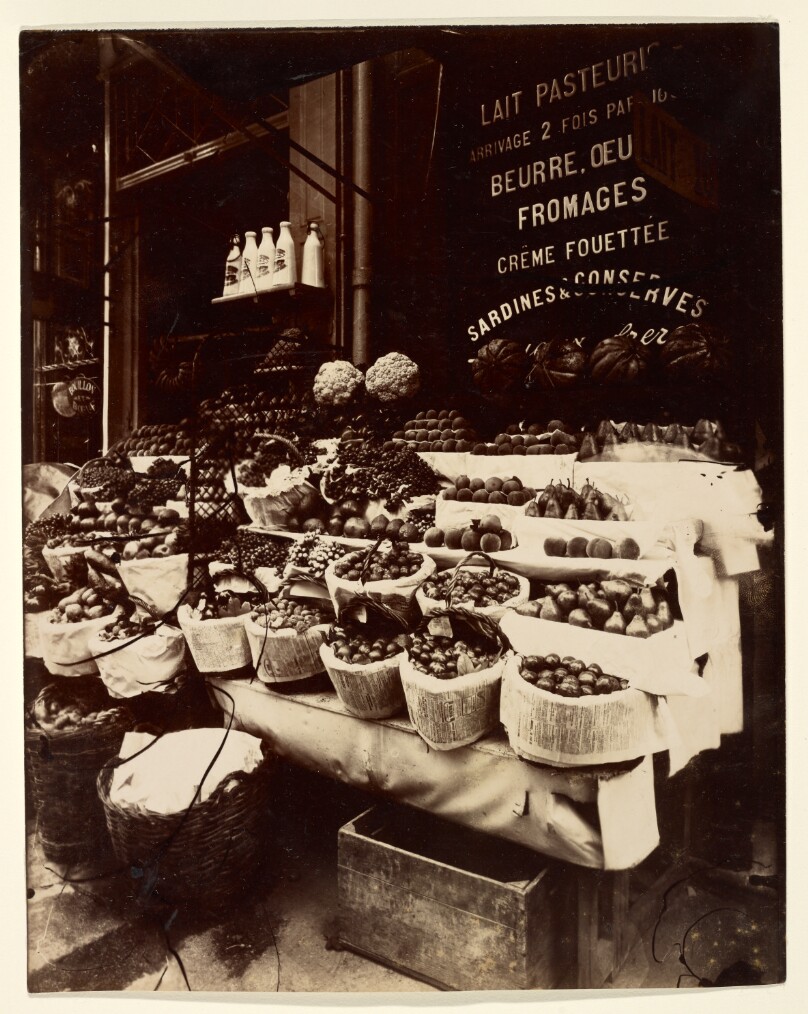
Rue Sainte-Opportune (Produce Display, rue Sainte-Opportune)
Creator
Eugène AtgetFrench Photographer · 1857–1927
All works by this person →Eugène Atget never called himself a photographer; instead he preferred "author-producer." A private, almost reclusive man, Atget first tried his hand at painting and acting, then began to photograph *vieux Paris* (Old Paris) in 1898. He photographed in part to create "documents," as he called his photographs, of architecture and urban views, but he supported himself by selling these photographs to
More on Getty ULAN- Date
- negative 1908 or 1912; print 1920s
- Medium
- Gelatin silver chloride printing-out paper print
- Culture
- French
- Department
- Photographs
- Institution
- Getty Museum
- Object ID
- aa34e403-39b2-43b2-8170-5094d5ef640e
From the Getty Museum record
> One of the persistent themes in Eugène Atget's work is his attention to the ways merchandise was presented on the streets of Paris to potential consumers, particularly of the working class. This store, located on the minuscule rue Sainte-Opportune, around the corner from Les Halles (see [94.XM.108.8](https://www.getty.edu/art/collection/objects/101151/eugene-atget-les-halles-french-about-1910/)), which was then the great central market of Paris, went to some trouble to arrange its fresh produce in a tidy fashion. To increase the attractiveness of the fruit and vegetables, the display containers were carefully lined with folded newspapers or white paper, no doubt replaced every day, and the shelves beneath them were covered with additional paper. As is often the case in Atget's photographs, the image conveys considerable information that is incidental to his primary focus. While the principal subject is the produce display, the lettering on the window advertises that this establishment also sold butter, eggs, cheese, whipping cream, sardines, preserves, and pasteurized milk that was delivered twice daily. Just as this picture is an inventory of the grapes, peaches, plums, broccoli, and pears available from this particular vendor, so also was Atget's series of sidewalk displays an inventory of the inventiveness of shopkeepers in presenting their wares to the public (see also [84.XM.1034.2](https://www.getty.edu/art/collection/objects/55716/eugene-atget-rue-du-petit-thouars-sic-french-1920-1927/), [84.XM.1034.4](https://www.getty.edu/art/collection/objects/55718/eugene-atget-rue-de-la-corderie-french-negative-1911-print-1920-1929/), [84.XM.1034.5](https://www.getty.edu/art/collection/objects/55719/eugene-atget-rue-de-la-reynie-tinsmith's-shop-rue-de-la-reynie-french-1912/), [90.XM.64.3](https://www.getty.edu/art/collection/objects/63439/eugene-atget-brocanteur-1-rue-de-la-reynie-4-french-1908/), [90.XM.64.9](https://www.getty.edu/art/collection/objects/63445/eugene-atget-berenice-abbott-epicerie-fruiterie-french-negative-1912-print-about-1927/), [90.XM.64.11](https://www.getty.edu/art/collection/objects/63447/eugene-atget-and-berenice-abbott-marche-des-carmes-place-maubert-french-negative-1910-1911-print-about-1927/), [90.XM.64.17](https://www.getty.edu/art/collection/objects/63452/eugene-atget-boutique-rue-de-sevres-french-negative-19101911-print-1920s/), [2002.37.23](https://www.getty.edu/art/collection/objects/172759/eugene-atget-rue-norvins-french-1924/)). > > Atget arranged his negatives in roughly chronological order in a series of complicated sets according to subject. The inscribed number on this photograph's glass negative indicates that it was created in either 1908 or 1912. The print was made on gelatin silver chloride printing-out paper, which Atget did not employ until the 1920s. The whiplash lines in the lower left corner of the print indicate that the negative was damaged after its creation, but Atget evidently still found it worth printing. > > Originally published in *Eugène Atget*, In Focus: Photographs from the J. Paul Getty Museum by Gordon Baldwin (Los Angeles: J. Paul Getty Museum, 2000), 46. ©2000, J. Paul Getty Trust.
The authoritative record is held by Getty Museum. LinkedCulture surfaces this object and its connections; it does not alter institutional metadata.
Get printable QR codesHide QR codes
Open QR codes for this object page and the museum record. They stay collapsed until needed.
Related across collections
Semantically similar works from Getty Museum and other institutions.