Getty Museum
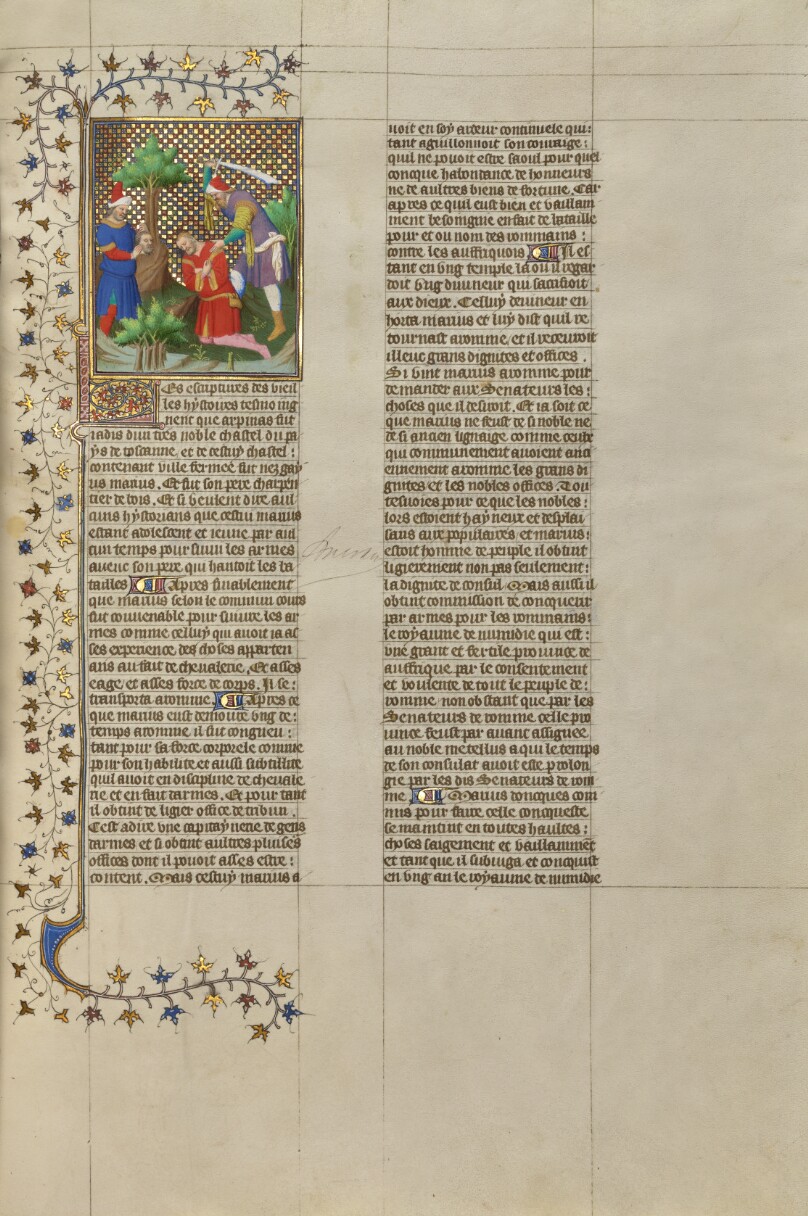
The Head of Marcus Shown to Caius Marius and the Killing of Marius
Creator
Boucicaut MasterFrench Illuminator · 1390–1430
All works by this person →In the early 1400s, the Boucicaut Master was the leading master of manuscript illumination in Paris and one of the most influential artists working in the International style in northern Europe. The Boucicaut Master appears to have supervised a talented team of artists who produced manuscripts commissioned by the king of France, high-ranking aristocrats, and the wealthy bourgeoisie. He probably al
More on Getty ULAN- Date
- about 1413–1415
- Medium
- Tempera colors, gold leaf, gold paint, and ink
- Culture
- French
- Department
- Manuscripts
- Institution
- Getty Museum
- Object ID
- af5275c4-4952-4eba-acc9-524b22e9f9d1
From the Getty Museum record
A man and woman stand side by side within an architectural framework on this grave relief. The top of the stele forms an arch with carved decoration and akroteria at the top and on the sides; pilasters on either side have capitals decorated by leaves. A Greek inscription at the bottom of the stele provides their names, and those of their family members. It reads, "Theaitetos for his mother Tation. Demetrios and Tation for their sweetest child Tatianos in memory. May whoever lays a hand heavy with [envy] on this grave be struck by a similarly premature blow of fate." The man (at left), Tatianos, wearing boots and armor, holds a whip by the handle, while his wife, Tation, gathers the wavy folds of her mantle across her thighs. The chiton beneath his armor falls below his knees. He has wide open eyes and curly hair decorated by a band. The woman wears a chiton with cloth wrapped around her body, and boots as well. Her hair hangs down on either side and curls upward at the ends. Objects beside the figures serve as attributes for their idealized identities as a soldier-farmer and a woman of beauty. The vine knife and writing tablets indicate that he was a soldier and a man of learning who owned livestock and a vineyard. His wife appears between a comb and a hand-held mirror, symbols of her beauty. The two-dimensional, frontal figures on this tombstone are characteristic of funerary reliefs from Phrygia (in present-day Turkey).
The authoritative record is held by Getty Museum. LinkedCulture surfaces this object and its connections; it does not alter institutional metadata.
Get printable QR codesHide QR codes
Open QR codes for this object page and the museum record. They stay collapsed until needed.
Related across collections
Semantically similar works from Getty Museum and other institutions.