Getty Museum
Attic Red-Figure Volute Krater
Creator
Kleophrades PainterPainter
All works by this person →Working in Athens in the period from about 505 to 475 B.C, the Kleophrades Painter was a prolific vase-painter--more than one hundred vases attributed to him survive. He very likely was the pupil of Euthymides, one of the group of the red-figure Pioneers. He primarily worked in the red-figure technique but occasionally used the black-figure technique with enough facility that he may have been trai
More on Getty ULAN- Date
- 480–470 B.C.
- Medium
- Terracotta
- Culture
- Greek (Attic)
- Department
- Vessels
- Institution
- Getty Museum
- Object ID
- b04ca462-6328-48dc-9a3b-1155922118c0
From the Getty Museum record
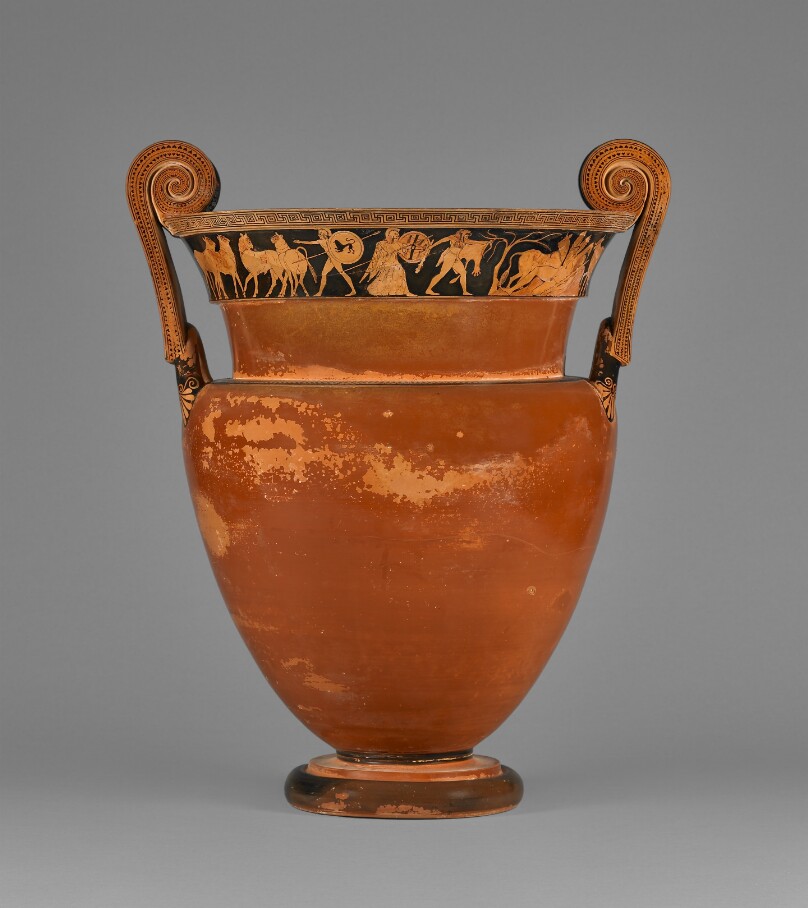
Scenes from the labors of the Greek hero Herakles encircle the neck of this Athenian red-figure volute-krater. On the front of the vase, Herakles' companion Iolaos prepares to drive off four cattle, while Herakles and the goddess Athena prepare to attack the sleeping giant Alkyoneus. He reclines on a rocky landscape underneath a leafless tree, club resting along his left arm. Behind and to the right of the giant are two more cattle. A small winged figure, Hypnos, sleeps nestled on Alkyoneus' torso. On the back of the vase, Herakles first subdues an ithyphallic, antlered mule – perhaps intended as the Keryneian hind. To the right, Herakles beheads the Lernean Hydra, while Iolaos stands on the other side of the monster, ready to cauterize the wounds with torches. To the right of Iolaos, Athena sits facing left holding out her helmet with her right hand and carrying a spear and shield with an owl device with her left. To the right of the goddess, a nude Herakles performs a third labor – wrestling the Nemean lion as a seated Iolaos looks on with club in hand. An intense red glaze covers the body of this volute-krater. Coral-red technique, the application of an intentional red surface on a vase, was an unusual process used almost exclusively on cups and small vessels. It may have entailed using a subtly different clay or firing the vase more than once. Its use on a large vase like this krater is extremely rare.
The authoritative record is held by Getty Museum. LinkedCulture surfaces this object and its connections; it does not alter institutional metadata.
Get printable QR codesHide QR codes
Open QR codes for this object page and the museum record. They stay collapsed until needed.
Related across collections
Semantically similar works from Getty Museum and other institutions.