Getty Museum
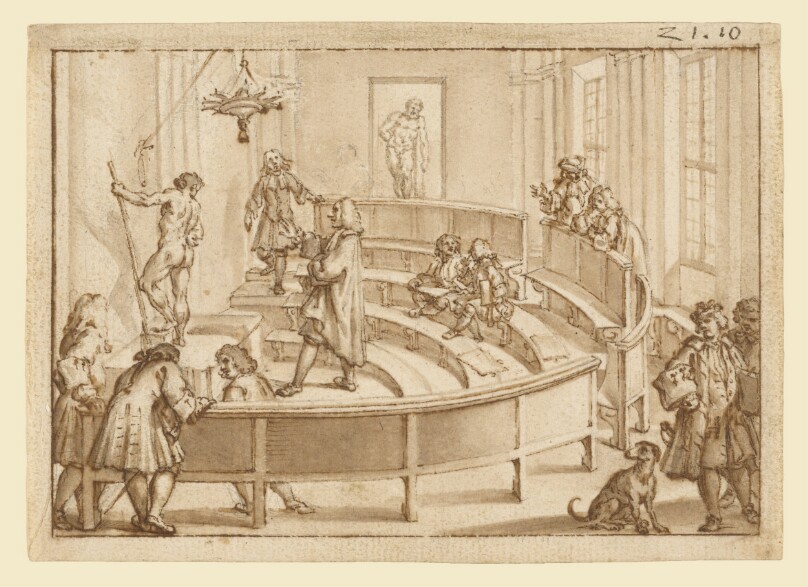
The "Accademia Clementina" Bologna, with a Nude Being Positioned by the Drawing Master, the "Farnese Hercules" beyond
Creator
Giampietro ZanottiItalian Artist · 1674–1765
All works by this person →Giampietro Zanotti had an active career as a painter, but today he is best known as a writer. He studied painting in Bologna, where he adopted the distinctive, graceful Rococo palette. Remaining primarily in Bologna, he created classicist paintings of biblical motifs. Zanotti knew many outstanding scholars and authors and wrote widely on art-related subjects. In 1710 he contributed a defense of Gu
More on Getty ULAN- Date
- 1739
- Medium
- Pen and brown ink over black chalk; the outlines indented for transfer
- Culture
- Italian
- Department
- Drawings
- Institution
- Getty Museum
- Object ID
- b0d62601-cae4-4fa8-923b-5dca1d073099
From the Getty Museum record
A life-drawing class is about to begin at Bologna's Accademia Clementina. At the center, the master directs the model's pose while the students talk animatedly. A background niche holds a plaster model or drawing of the ancient Roman sculpture, the *Farnese Hercules.* The master's features, particularly his large nose, suggest that Zanotti may have portrayed himself here. To continue the Bolognese painting tradition established by the Carracci, particularly its emphasis on life drawing from the nude, Zanotti helped to found the Accademia Clementina in 1710. Life drawing was the basis of instruction at the Accademia, so the subject was appropriate for this drawing, the basis for an engraved frontispiece to Zanotti's *Storia dell'Accademia Clementina di Bologna* of 1739. Zanotti began by sketching with black chalk, then went over those lines with pen and ink. His thought process is evident in the chalk underdrawing of the lamp and its rope, which he initially drew farther to the left. Zanotti, who probably also made the engraving, went over the principal outlines with the stylus to transfer the design to the copperplate for engraving.
The authoritative record is held by Getty Museum. LinkedCulture surfaces this object and its connections; it does not alter institutional metadata.
Get printable QR codesHide QR codes
Open QR codes for this object page and the museum record. They stay collapsed until needed.
Related across collections
Semantically similar works from Getty Museum and other institutions.