Getty Museum
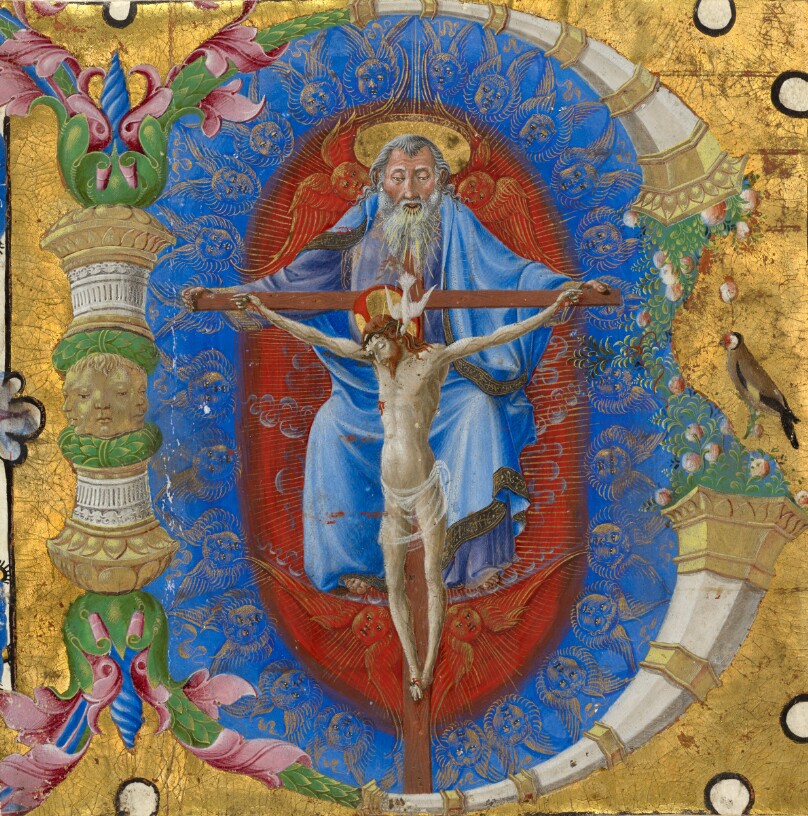
Initial B: The Trinity
Creator
Taddeo CrivelliItalian Illuminator · 1479–1479
All works by this person →Taddeo Crivelli was one of the illuminators who introduced the Renaissance style into manuscript painting in Ferrara. His first known miniatures date to the early 1450s. In the period roughly coinciding with the rule of Borso d'Este over Ferrara, Crivelli and his workshop were engaged in a number of projects, producing a variety of books for aristocratic patrons as well as for religious institutio
More on Getty ULAN- Date
- about 1460–1470
- Medium
- Tempera and gold
- Culture
- Italian
- Department
- Manuscripts
- Institution
- Getty Museum
- Object ID
- b1683de6-78d0-4d9f-a6e2-782b6452d321
From the Getty Museum record
Seeming to emerge from the background and float in front of it, the Trinity shown in this illumination has an assertive presence. Crivelli created a visually dynamic painting by contrasting the manner of representation in the main figural group with that of the background. In contrast to the sculptural clarity of the Trinity, the golden angels' heads in the background are painted in such a manner that they are partially formed out of the expanse of blue and red space, making them spatially ambiguous and ethereal. The Trinity represents the unity of the Father, Son, and Holy Spirit as three persons in one Godhead according to Catholic belief. The Trinity is shown here as God the Father holding the Crucified Christ with the dove representing the Holy Spirit between the two. This initial probably comes from a choir book that contained the sung portions of the Mass, where it introduced a text used on Trinity Sunday.
The authoritative record is held by Getty Museum. LinkedCulture surfaces this object and its connections; it does not alter institutional metadata.
Get printable QR codesHide QR codes
Open QR codes for this object page and the museum record. They stay collapsed until needed.
Related across collections
Semantically similar works from Getty Museum and other institutions.