Getty Museum
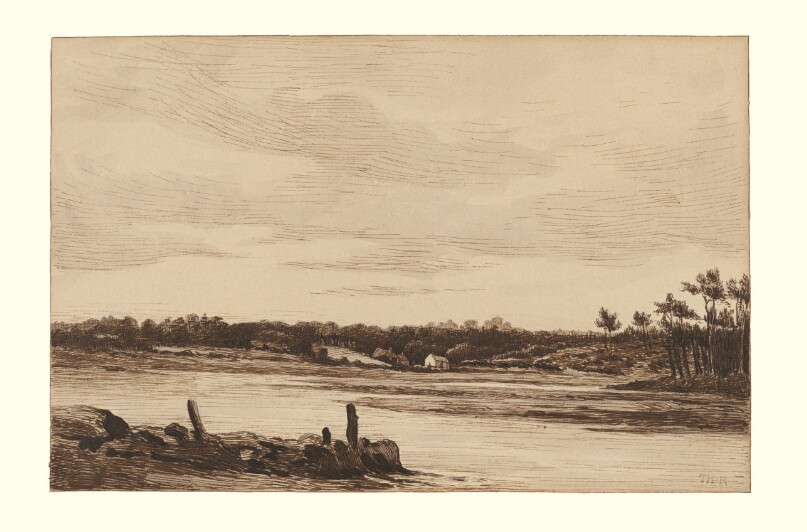
The Loing River at the Edge of the Forest of Fontainebleau
Creator
Théodore RousseauFrench Artist · 1812–1867
All works by this person →From his boyhood, Théodore Rousseau passionately loved nature. He trained with academic landscapists, but his insistence on "keep[ing] in mind the virgin impression of nature" and painting pure landscape without a mythological theme earned him the hostility of France's academic establishment, making him both famous and poor. His unswerving determination to paint pure landscapes directly from natur
More on Getty ULAN- Date
- about 1830
- Medium
- Pen and black ink and gray wash, on laid paper
- Culture
- French
- Department
- Drawings
- Institution
- Getty Museum
- Object ID
- b2faf8dd-197b-4f3f-949f-0fd4cd49aacf
From the Getty Museum record
The wide, smooth river Loing, a branch of the Seine, wraps around the Forest of Fontainebleau, located fifty miles south of Paris. In this drawing Théodore Rousseau focused on the large expanse of sky that seems to compress the land into a flat, dark band beneath it. Only a few trees and rocky outcrops project upwards, breaking the winding lines of the river and sandy banks. Rousseau produced the scene outside in the open air, near the village of Barbizon, an area popularized by the group of artists who gathered there in the mid-1800s. They came to draw and paint the region's varied topography, where lush glades of oak and beech give way to semi-deserts of sand, scrub, and pines. Rousseau was particularly fond of the Forest of Fontainebleau, producing many scenes of it for over thirty years. In this drawing, sketched near the end of his life, he concentrated more on the movement of the clouds in the sky than on the details on the land, preferring to reduce individual elements to simple patterns of light and shadow.
The authoritative record is held by Getty Museum. LinkedCulture surfaces this object and its connections; it does not alter institutional metadata.
Get printable QR codesHide QR codes
Open QR codes for this object page and the museum record. They stay collapsed until needed.
Related across collections
Semantically similar works from Getty Museum and other institutions.