Getty Museum
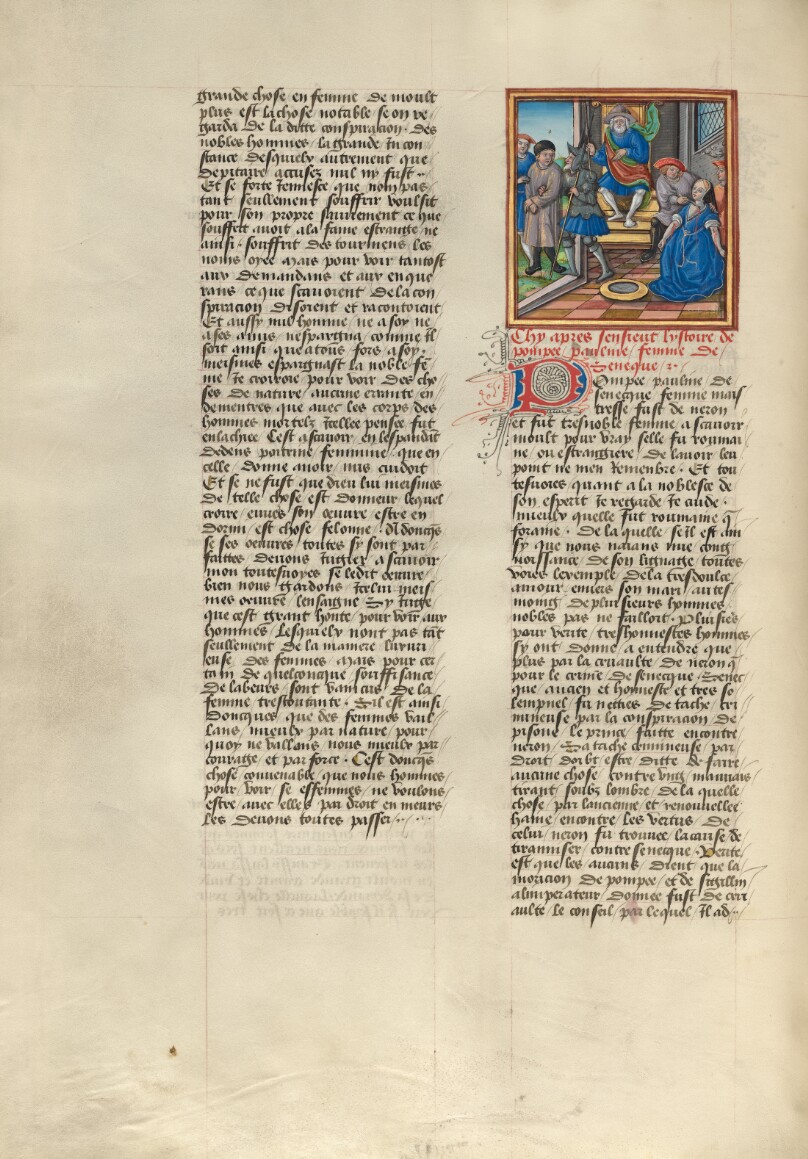
Pompeia Paulina Attempting Suicide
- Date
- about 1450–1475, illumination added about 1515–1520
- Medium
- Tempera colors, gold, and ink
- Culture
- French
- Department
- Manuscripts
- Institution
- Getty Museum
- Object ID
- b39967b9-47f5-4ec9-b85b-9de83740d516
From the Getty Museum record
After her husband Seneca was forced by the emperor Nero to choose the manner of his own death, Pompeia Paulina decided to follow him to the grave by slicing open her veins. Yet, the emperor, here shown seated on his throne, did not want Pompeia to die for her husband’s guilt, and so had her bleeding stopped. According to the myth, Pompeia had been so close to dying that she forever more had the white pallor of death. In this image, Pompeia’s arms bleed from her self-inflicted wounds, her white pallor evident, while a man leans over, seemingly slicing her neck as her husband is led away by a soldier and courtier. This detail is not included in the text and possibly indicates a misunderstanding on the part of the illuminator. Yet, at the same time, before Pompeia lies the bowl of warm water that she stepped in while opening her veins, showing a close reading of at least some of the textual details by the artist.
The authoritative record is held by Getty Museum. LinkedCulture surfaces this object and its connections; it does not alter institutional metadata.
Get printable QR codesHide QR codes
Open QR codes for this object page and the museum record. They stay collapsed until needed.
Related across collections
Semantically similar works from Getty Museum and other institutions.