Getty Museum
New York
Creator
Paul StrandAmerican Photographer · 1890–1976
All works by this person →Paul Strand began photographing in New York in the 1910s. During the early 1920s he received recognition for both his painting and his photography. He visited New Mexico in 1926 and, beginning in 1930, returned for three consecutive summers, making portraits of artist friends and acquaintances. It was there, amidst a community of visual artists and writers, that Strand began to develop his belief
More on Getty ULAN- Date
- 1917
- Medium
- Silver platinum print
- Culture
- American
- Department
- Photographs
- Institution
- Getty Museum
- Object ID
- b79e764b-7893-4e94-97bf-f0f1a40de5af
From the Getty Museum record
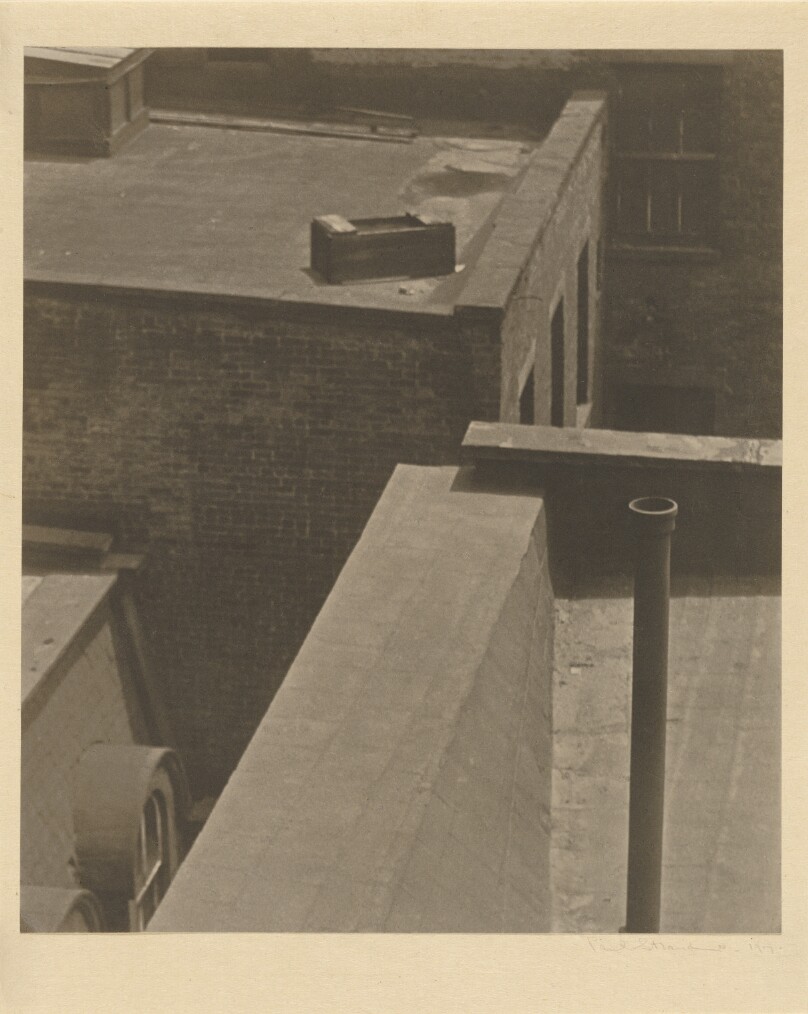
The International Exhibition of Modern Art, held in New York at the 69th Regiment Armory, drew large crowds to its galleries during the run of the show (February 17-March 15, 1913). Paul Strand was among the throngs of people (more than a hundred thousand) who waited in line to see the work of American artists alongside that of Europeans such as Georges Braque (1882-1963), [Paul Cézanne](https://www.getty.edu/art/collection/object/103QVS) (1839-1906), and [Pablo Picasso](https://www.getty.edu/art/collection/object/109J7B) (1881-1973). Although at first bemused by the modern art on display, Strand was very much influenced and inspired by the new principles it promoted and began exploring the same ideas in his own photographic work. Taken from a New York rooftop, this bold, angular composition broken down into architectural facets that together create an interesting array of shapes and forms and a play of light and shadow. Abandoning traditional axioms of perspective and representation, he explored the strong diagonals of building rooftops and facades. as an end unto itself. The photograph is amazingly simple in its execution yet strikingly complex in its arrangement. It was a radical departure from Strand's early Pictorialist work. Having seen examples of Strand's prints, Alfred Stieglitz (1864-1946) offered the young photographer a show in 1916 at 291, as his Little Galleries of the Photo-Secession had come to be known. The opportunity was quite an endorsement, for no photographs had been shown at 291 since 1913, when Stieglitz had displayed his own work there. Stieglitz, who had gradually moved away from the Pictorialist style of the Photo-Secession, in spite of being its major proponent at one time, was now advocating a more direct approach in photography and saw Strand's prints as the embodiment of his own principles. Originally published in _Paul Strand_, In Focus: Photographs from the J. Paul Getty Museum by Anne M. Lyden (Los Angeles: J. Paul Getty Museum, 2005), 16. ©2005, J. Paul Getty Trust.
The authoritative record is held by Getty Museum. LinkedCulture surfaces this object and its connections; it does not alter institutional metadata.
Get printable QR codesHide QR codes
Open QR codes for this object page and the museum record. They stay collapsed until needed.
Related across collections
Semantically similar works from Getty Museum and other institutions.