Getty Museum
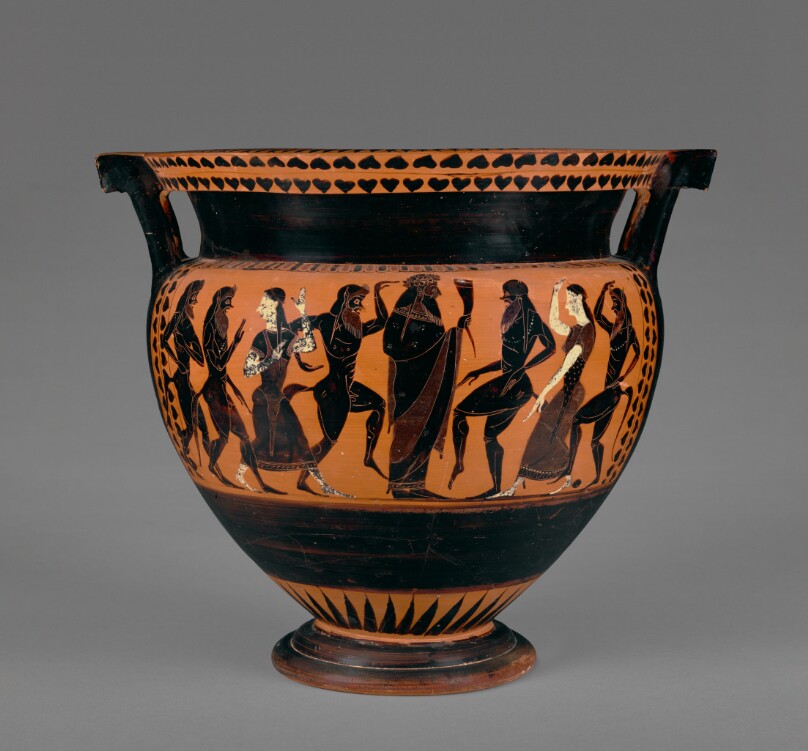
Attic Black-Figure Column Krater
Creator
Painter of Munich 1736Painter
All works by this person →Working in Athens in the years around 520 B.C., the Painter of Munich 1736 decorated vases in the black-figure technique. He was one of several painters who worked in the style of the Lysippides Painter. His surviving work includes large vases, like amphorae and column kraters, which he decorated with Dionysiac scenes. As with most ancient artists, the real name of the Painter of Munich 1736 is un
More on Getty ULAN- Date
- about 520 B.C.
- Medium
- Terracotta
- Culture
- Greek (Attic)
- Department
- Vessels
- Institution
- Getty Museum
- Object ID
- b80357f0-d517-417d-9823-e598c31a930e
From the Getty Museum record
Dionysos, the god of wine, stands calmly in the midst of a group of dancing maenads and satyrs on this Athenian black-figure column-krater. Wearing a festive wreath of ivy leaves and holding his drinking horn, the god appears unaffected by the frenzy of his companions. Scenes with Dionysos were a favorite decoration for vessels like this column-krater, which would have been used at a symposion or drinking party to mix the wine with water. On the other side of the vase, two lions ravage a bull. The motif of the lion attack was central to Greek art and literature from the 800s through the 500s B.C. and served as a metaphor for heroic or even divine triumph. It was referenced in a wide variety of contexts, from the epic poems of Homer, to the sculpture on monumental temples, to the decoration on vases made for private use, such as this one. Plant motifs decorate the rim of the vessel. Ivy leaves cover the outer edge, and lotus buds encircle the top. The bearded heads on the handle-plates were a typical decoration for column-kraters.
The authoritative record is held by Getty Museum. LinkedCulture surfaces this object and its connections; it does not alter institutional metadata.
Get printable QR codesHide QR codes
Open QR codes for this object page and the museum record. They stay collapsed until needed.
Related across collections
Semantically similar works from Getty Museum and other institutions.