Getty Museum
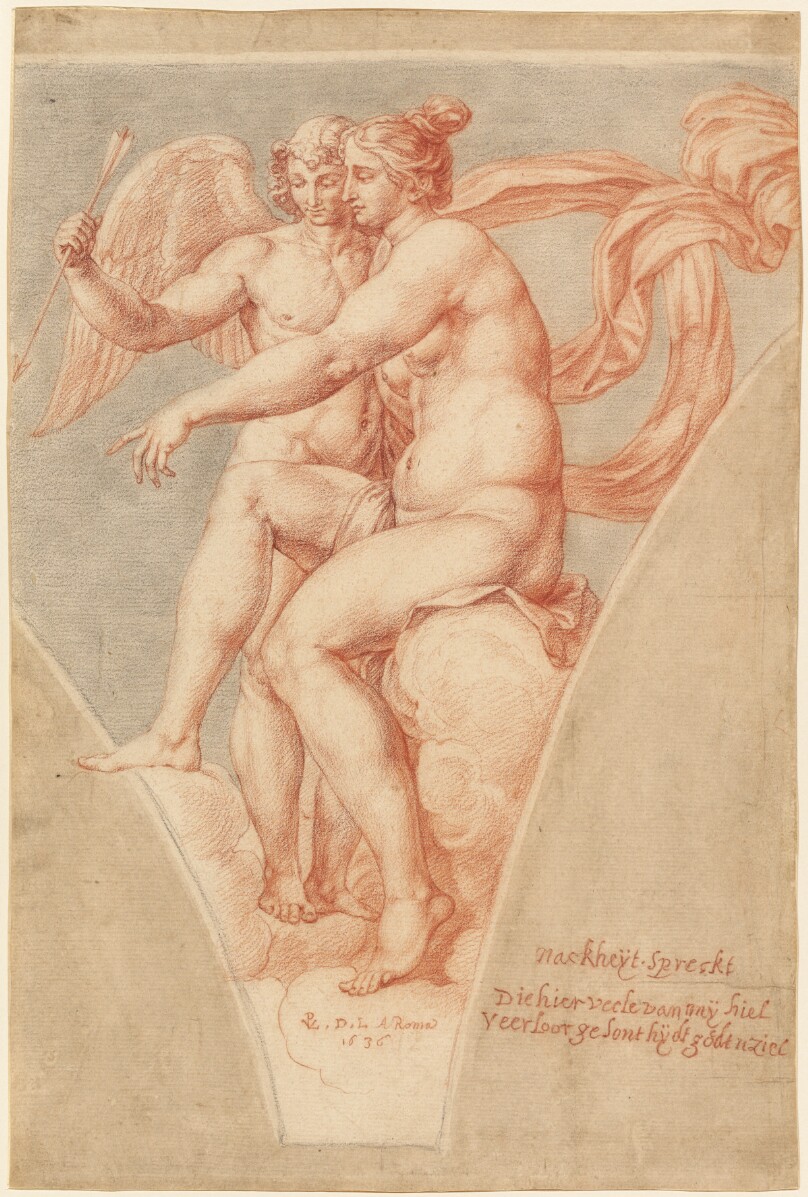
Venus and Cupid (after Raphael) (2000.26)
Creator
Pieter van LintFlemish Artist · 1609–1690
All works by this person →After becoming a master in 1632, Pieter van Lint left Antwerp for Rome, where he worked for a prominent family as well as for a Roman Catholic cardinal. While in Rome he painted a series of frescoes illustrating the legend of the *History of the True Cross.* During this period, van Lint made his most successful drawings--copies after the antique and after great Renaissance masters, richly rendered
More on Getty ULAN- Date
- 1636
- Medium
- Black and red chalk and brown wash
- Culture
- Flemish
- Department
- Drawings
- Institution
- Getty Museum
- Object ID
- b864b6bf-a297-4515-9dfb-41caaa0f8124
From the Getty Museum record
>By the sweet wound of thy piercing darts, ...revenge the injury which is done to thy mother, by the false and disobedient beauty of a mortal maiden... that she may fall in love with the most miserable creature living, the most poor, the most crooked, and the most vile... In an event from one of the greatest love stories in Greek mythology, Cupid stands with his arrow poised to strike, while his mother Venus points to his target, the mortal Psyche. Because of Psyche's beauty, people had begun to worship her rather than Venus. Outraged at this mortal usurping her honor, Venus commanded Cupid to avenge her. Cupid, however, foiled his mother's plans, and Psyche did not fall in love with any such wretched creature. Having pricked himself with his own arrow so that he would love Psyche, Cupid protected her. His enraged mother subjected the lovers to many trials before their eventual marriage. Pieter van Lint copied this subject from the corner of a curved ceiling in a Roman villa that was painted by Raphael's pupils in 1518. He accurately repeated the foreshortening of the figures, but he exaggerated the voluminous proportions of the female nude.
The authoritative record is held by Getty Museum. LinkedCulture surfaces this object and its connections; it does not alter institutional metadata.
Get printable QR codesHide QR codes
Open QR codes for this object page and the museum record. They stay collapsed until needed.
Related across collections
Semantically similar works from Getty Museum and other institutions.