Getty Museum
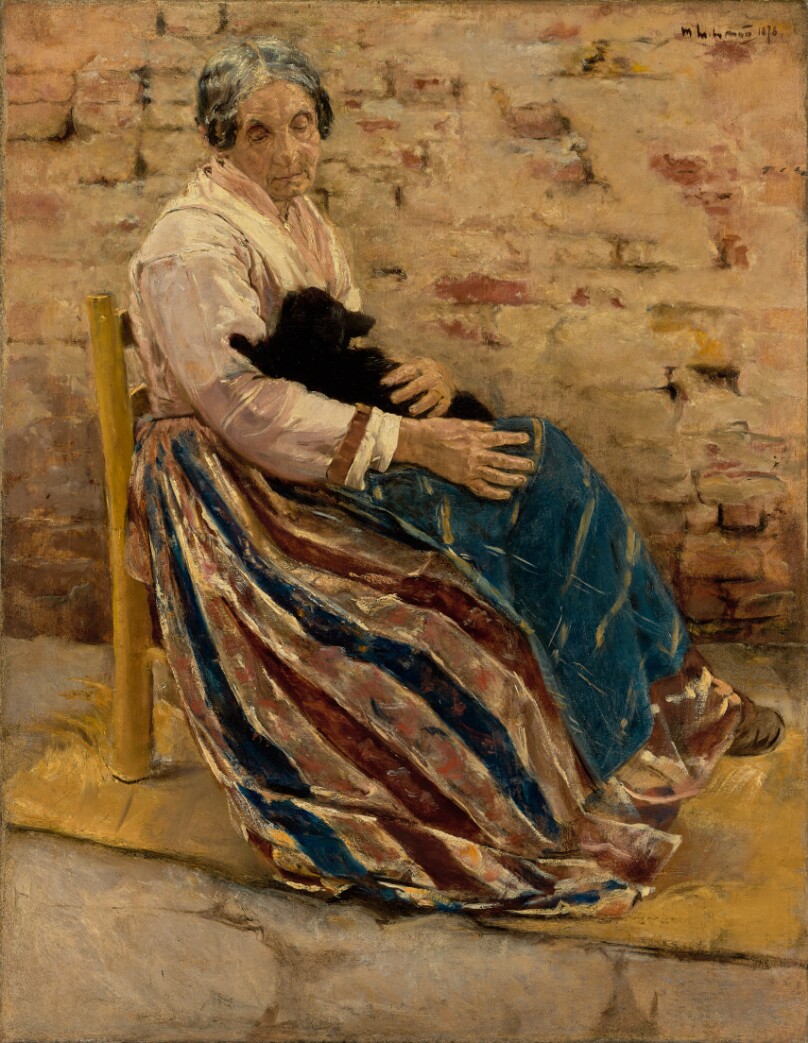
Woman with a Cat
Creator
Max LiebermannGerman Artist · 1847–1935
All works by this person →When Max Liebermann exhibited *Women Plucking Geese* in Berlin, critics branded him an "apostle of ugliness." So began his career as a painter, draftsmen, printmaker and collector, spanning more than fifty years. The son of a German Jewish businessman, Liebermann began his art studies in 1866. Like the Realist painters he greatly admired--especially Gustave Courbet and Jean-François Millet--Lieber
More on Getty ULAN- Date
- 1878
- Medium
- Oil on canvas
- Culture
- German
- Department
- Paintings
- Institution
- Getty Museum
- Object ID
- b9f1a9f6-e065-43bf-8757-cb69aef991cf
From the Getty Museum record
In a quiet and contemplative moment, an elderly woman sits in a chair, holding a black cat. Against the light-filled and rather sparse setting, the bright stripes of her skirt and striking black of the cat’s fur draw our eyes to this focal point of the composition. The woman’s pose, with head bowed to the side and hands gently embracing the cat, seems to reflect an emotional bond between the two. Her body language recalls traditional European images of motherhood and even Christian depictions of Mary with her infant son Jesus. German artist Max Liebermann was indebted to the Realism movement, which emerged in the 1840s with French painters like [Gustave Courbet (1819–1877)](https://www.getty.edu/art/collection/artists/365/gustave-courbet-french-1819-1877/) and [Jean-François Millet (1814–1875)](https://www.getty.edu/art/collection/artists/581/jean-francois-millet-french-1814-1875/). Realism and Liebermann’s work challenged artistic tradition and conventional ideals of beauty by painting common people, rather than only the wealthy and nobility, and using a rougher painting style where brushstrokes are visible. Critics in his time called Liebermann an “apostle of ugliness” and “painter of filth” because they did not appreciate his often-somber paintings that depicted working people going about their everyday lives. However, Liebermann believed in social reform to help the disadvantaged, so throughout his career he continued to paint sympathetic portrayals of the lower classes.
The authoritative record is held by Getty Museum. LinkedCulture surfaces this object and its connections; it does not alter institutional metadata.
Get printable QR codesHide QR codes
Open QR codes for this object page and the museum record. They stay collapsed until needed.
Related across collections
Semantically similar works from Getty Museum and other institutions.