Getty Museum
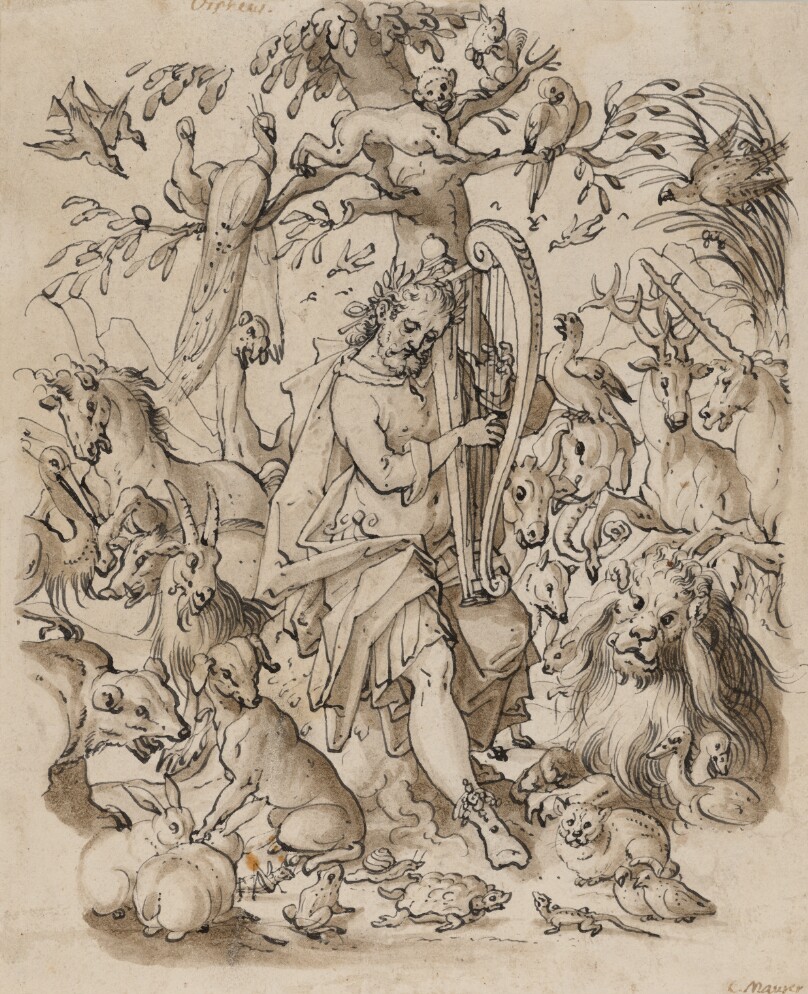
Orpheus Charming the Animals
Creator
Josias Murer IISwiss Artist · 1564–1630
All works by this person →Josias Murer, who was part of a family of artists living in Zurich in the fifteen and sixteen hundreds, became the exclusive glass painter of Zurich's city hall in 1591. He was fully occupied with this distinguished commission until 1614. Murer was trained by his father, Jos Murer, with whom he often worked. He also frequently worked with his well-known brother, Christoph Murer. In addition to his
More on Getty ULAN- Date
- about 1600
- Medium
- Black ink and brown wash, on paper
- Culture
- Swiss
- Department
- Drawings
- Institution
- Getty Museum
- Object ID
- baee2fd9-7a23-40de-8601-2739125e4da8
From the Getty Museum record
According to Greek myth, the poet Orpheus played the lyre with such magical sweetness that he charmed the animals, birds, and reptiles that gathered around him, subduing their innate hostilities. Orpheus sits in the center of the drawing focused on his music, while around him birds perch overhead, a frog, lizard, and pair of doves crouch at his feet, and horses, deer, an elephant, a goat, and a unicorn draw near. Josias Murer belonged to a family of Swiss glass-painters who worked in and around Zurich in the late 1500s. Scholars know that he produced this drawing as a design for a stained-glass panel, since Murer left a blank border around the composition. No panel with this illustration still survives. The theme of Orpheus charming the animals was one of the most popular among artists living in Northern Europe in the 1500s and 1600s. During this era of intense political upheaval and religious strife, the story came to express the hope in the power of art and poetry to conquer, and even resolve, irreconcilable conflict.
The authoritative record is held by Getty Museum. LinkedCulture surfaces this object and its connections; it does not alter institutional metadata.
Get printable QR codesHide QR codes
Open QR codes for this object page and the museum record. They stay collapsed until needed.
Related across collections
Semantically similar works from Getty Museum and other institutions.