Getty Museum
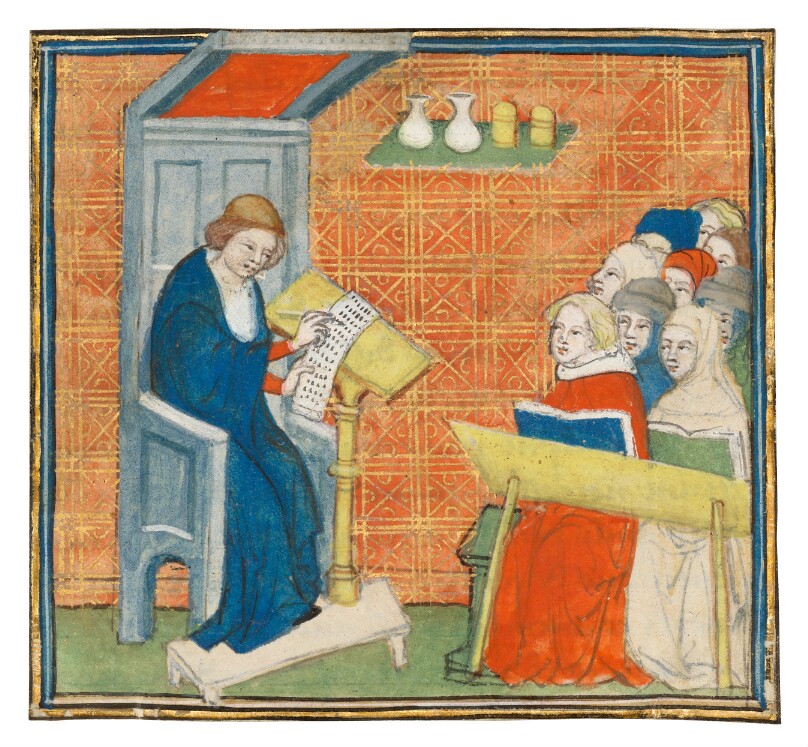
Six Cuttings from Bartholomaeus Anglicus, Livre des propriétés des choses
Creator
Perrin RemietFrench Illuminator · 1368–1428
All works by this person →- Date
- about 1400
- Medium
- Tempera colors and gold
- Culture
- French
- Department
- Manuscripts
- Institution
- Getty Museum
- Object ID
- c12f01da-c833-4fc8-a317-d647884ab5f0
From the Getty Museum record
These illuminations once illustrated six of the nineteen books of *On the Properties of Things*, written by Parisian scholar Bartholomaeus Anglicus around 1240 in Magdeburg in modern-day Germany. From birds to medical treatments all the way to Christian conceptions of God and time, the comprehensive manuscript from which this cutting originates was considered a kind of encyclopedia of all knowledge, seamlessly bringing religious, social, scientific, and medical discourses together. Removed from a now lost French copy of the work written about a century after the initial composition of the text in Latin, the Getty’s six cuttings can be assigned to specific books based on the subjects of their images and on the texts found on their reverses. *A Teacher Lectures on the Four Humors* comes from Book IV on that subject; *Two Patients before a Doctor* from Book V on the human body; *An Elderly Man with a Cane Approaches a Group* from Book VI on society; *A Scholar Points to a Roundel featuring a City* from Book XI on the element of air; *Four Birds* from Book XII on avian subjects; and, finally, *A Landscape* comes from Book XV on regions of the earth. These leaves show the breadth of Bartholomaeus Anglicus’s text and reveal the encyclopedic impulse of medieval scholarly authors in the thirteenth century. Usually unillustrated, the Latin version of the text was popular as a university textbook in late medieval Paris; in 1372 the French King Charles V (1338–80) commissioned the Augustinian friar Jean Corbechon to produce a French translation of the work. The illuminations in this lost copy were likely executed by artists in the circle of Perrin Remiet (1386–1428), one of the most prolific illuminators working in Paris towards the end of the fourteenth century and the beginning of the fifteenth century. Remiet’s illuminations are characterized by pale figures set against intricately patterned backgrounds, and he is known to have created images for another copy of *On the Properties of Things* as well as works of history that were especially popular among his aristocratic clientele. The manuscript’s original scheme of illumination likely featured miniatures placed at the beginning of each of the nineteen books, representing some of the salient features of each section of text. These images would help the reader to find their place within the tome and perhaps help them memorize the information elaborated therein.
The authoritative record is held by Getty Museum. LinkedCulture surfaces this object and its connections; it does not alter institutional metadata.
Get printable QR codesHide QR codes
Open QR codes for this object page and the museum record. They stay collapsed until needed.
Related across collections
Semantically similar works from Getty Museum and other institutions.