Getty Museum
Subgeometric Plate
Creator
Crane PainterPainter
All works by this person →- Date
- 680–660 B.C.
- Medium
- Terracotta
- Culture
- Etruscan (Caeretan)
- Department
- Vessels
- Institution
- Getty Museum
- Object ID
- c13eaf3c-de15-49d7-95a7-e3db59a35fae
From the Getty Museum record
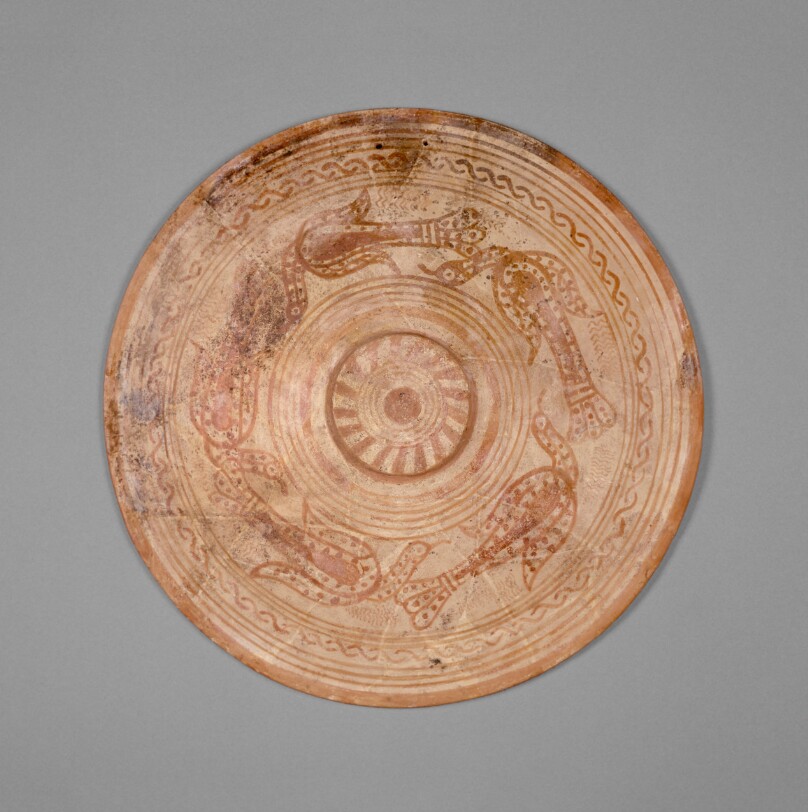
A wide flaring bowl rises from a low flat foot to a broad horizontal rim, below which are two perforations for suspension. One thick band of red slip, then four narrow bands surround the foot; three narrow bands, a simple guilloche frieze, three concentric circles, and a wide band at the rim form the outer border of the bird frieze. On the underside, a large central dot, four more concentric circles, and a pinwheel-like band of seventeen elements. The interior is decorated simply with concentric bands of thinly applied red slip. On the exterior, five large birds fly from left to right. Each bird has a long neck, a round head with a prominent eye, and a curved beak represented by a single stroke. The curving neck, wings, perimeter of the body, and three tail feathers are drawn inn outline and enlivened by rows of large dots. Beneath (or sometimes between) the birds are rows of delicate wavy lines. The Etruscan term for this type of plate, "spanti," is inscribed on a few typical examples from Cerveteri and environs. The plates' function remains uncertain, but the presence of suspension holes on some examples indicates that they were hung on a wall or stand. It is likely that this Etruscan form ultimately derives from an eighth-century-B.C. Phoenician prototype. Phoenician red-slip plates, which were imported to Etruria, are especially close in shape and share the frequent presence of similar concentric circles. The Etruscan potter created a new class of pottery by merging this Phoenician shape with a Greek decorative scheme.
The authoritative record is held by Getty Museum. LinkedCulture surfaces this object and its connections; it does not alter institutional metadata.
Get printable QR codesHide QR codes
Open QR codes for this object page and the museum record. They stay collapsed until needed.
Related across collections
Semantically similar works from Getty Museum and other institutions.