Getty Museum
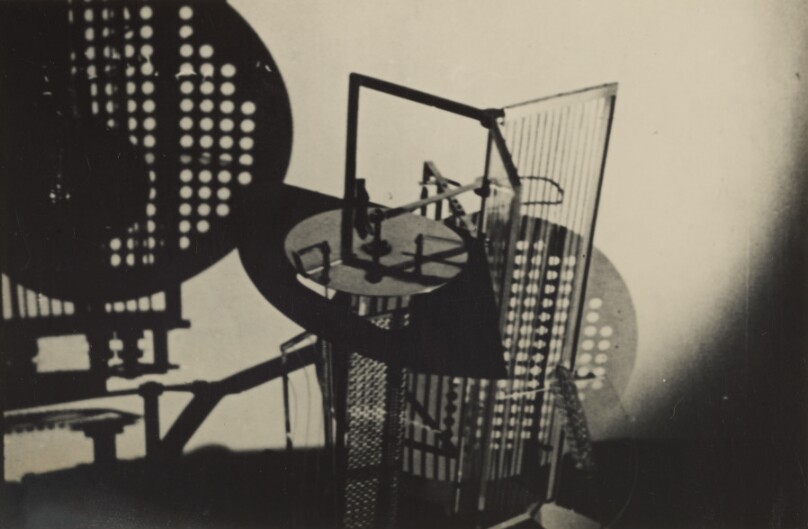
aus dem lichtspielfilm schwarz-weiss-grau
Creator
László Moholy-NagyAmerican Photographer · 1895–1946
All works by this person →> The reality of our century is technology: the invention, construction and maintenance of machines. To be a user of machines is to be of the spirit of this century. Machines have replaced the transcendental spiritualism of past eras. > > --László Moholy-Nagy > > Perhaps more than any other artist in the Getty Museum collection, László Moholy-Nagy would have delighted in the presentation of his im
More on Getty ULAN- Date
- 1930
- Medium
- Gelatin silver print
- Culture
- American
- Department
- Photographs
- Institution
- Getty Museum
- Object ID
- c2adf052-c855-480e-a449-df3ba4c9ae7a
From the Getty Museum record
> The *Light-Space Modulator* is the most spectacular and complete realization of László Moholy-Nagy’s artistic philosophy. Machine parts and mechanical structures began to appear in his paintings after his emigration from Hungary, and they are also seen in the illustrations he selected for the 1922 *Buch neuer Künstler* (Book of new artists), which includes pictures of motorcars and bridges as well as painting and sculpture. Many contemporary artists incorporated references to machines and technology in their work, and some, like the Russian Constructivist Vladimir Tatlin, even designed plans for fantastic structures, such as the ambitious *Monument to the Third International*, a proposed architectural spiral of glass and steel with moving tiers and audiovisual broadcasts. (See [Tatlin's Tower](https://en.wikipedia.org/wiki/Tatlin%27s_Tower).) > > In the *Light-Space Modulator*, Moholy-Nagy was able to create an actual working mechanism. Although he censured capitalism’s inhumane use of technology, he believed it could be harnessed to benefit mankind and that the artist had an important role in accomplishing this. Moholy had made preliminary sketches for kinetic sculptures as early as 1922 and referred to the idea for a light machine in his writings, but it was not until production was financed by an electric company in Berlin in 1930 that this device was built, with the assistance of an engineer and a metalsmith. It was featured at the Werkbund exhibition in Paris the same year, along with the short film *Light Display Black-White-Gray*, made by Moholy-Nagy to demonstrate and celebrate his new machine. > > The *Light-Space Modulator* is a Moholy-Nagy painting come to life: mobile perforated disks, a rotating glass spiral, and a sliding ball create the effect of photograms in motion. With its gleaming glass and metal surfaces, this piece (now in the collection of the [Busch-Reisinger Museum at Harvard University](https://www.harvardartmuseums.org/art/299819)) is not only a machine for creating light displays but also a sculptural object of beauty, photographed admiringly by its creator. (See also: [84.XP.912.2](http://www.getty.edu/art/collection/objects/45320/laszlo-moholy-nagy-das-lichtrequisit-american-1930/) and [84.XP.912.3](http://www.getty.edu/art/collection/objects/45321/laszlo-moholy-nagy-das-lichtrequisit-american-1930/)) > > Katherine Ware, *László Moholy-Nagy*, In Focus: Photographs from the J. Paul Getty Museum (Los Angeles: J. Paul Getty Museum, 1995), 80. © 1995 The J. Paul Getty Museum.
The authoritative record is held by Getty Museum. LinkedCulture surfaces this object and its connections; it does not alter institutional metadata.
Get printable QR codesHide QR codes
Open QR codes for this object page and the museum record. They stay collapsed until needed.
Related across collections
Semantically similar works from Getty Museum and other institutions.