Getty Museum
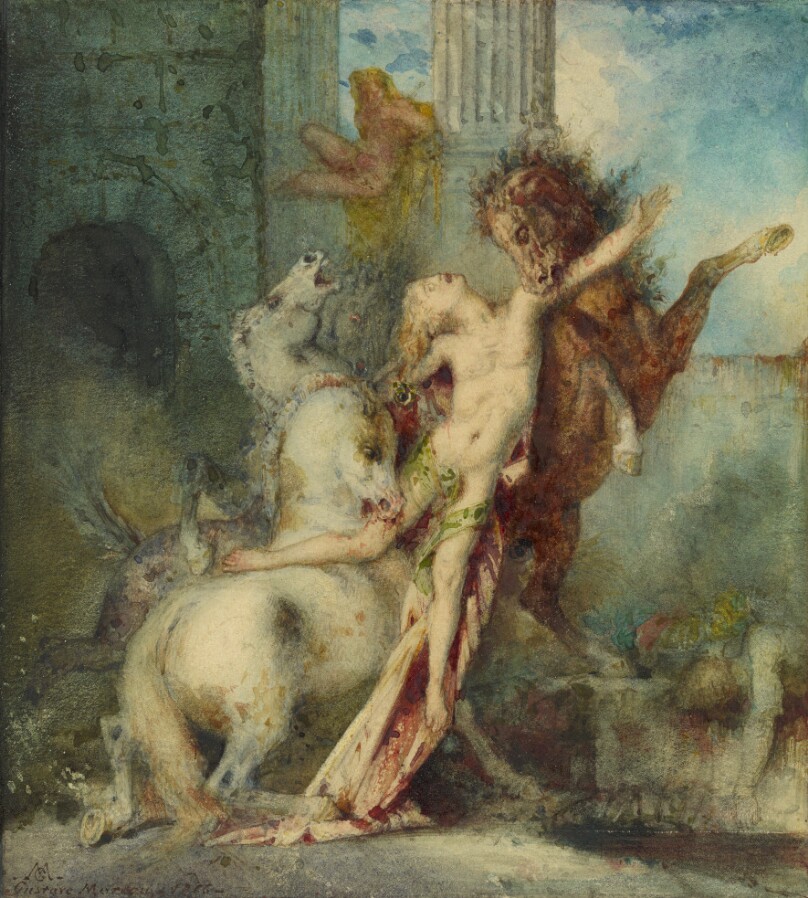
Diomedes Devoured by Horses
Creator
Gustave MoreauFrench Artist · 1826–1898
All works by this person →In an era when paintings of mythological subjects often meant sentimentalized renderings or cold recitations of classical sculpture, Gustave Moreau was a pioneer with his intensely personal, fantastic, even perverse, interpretations. His works appeared in the 1860s but they anticipated the Symbolist work of the 1880s, which explored interior consciousness rather than exterior observation. "I belie
More on Getty ULAN- Date
- 1866
- Medium
- Watercolor over graphite
- Culture
- French
- Department
- Drawings
- Institution
- Getty Museum
- Object ID
- c46ff6fb-88c8-4ade-a4f6-ff025909f276
From the Getty Museum record
As the shadowy figure of Hercules observes from between two columns in the background, four wild horses rip apart the slender body of King Diomedes. The brown mare fastens her teeth on his arm, while another sinks her jaw into his leg. Bodies of the horses' previous victims lie piled to the right, above a pool of blood-stained water. This scene shows the dramatic climax from the eighth labor of Hercules, who was ordered to capture the four flesh-eating horses belonging to King Diomedes. Hercules killed the king in battle and fed his body to the horses, which tamed them. Gustave Moreau's fascination with violent, emotionally charged subjects portrayed in jewel-like colors typifies mid-1800s French painting. Here Moreau's luminous and delicately applied watercolor washes enhance an already dramatic scene, highlighting the vertical body of the doomed Diomedes, whose extended, stretched limbs repeat the dynamic rearing motion of the brown horse's front legs. In calm contrast, Hercules rests in the background, silhouetted against a blue sky subtly rendered with light patches of wash.
The authoritative record is held by Getty Museum. LinkedCulture surfaces this object and its connections; it does not alter institutional metadata.
Get printable QR codesHide QR codes
Open QR codes for this object page and the museum record. They stay collapsed until needed.
Related across collections
Semantically similar works from Getty Museum and other institutions.