Getty Museum
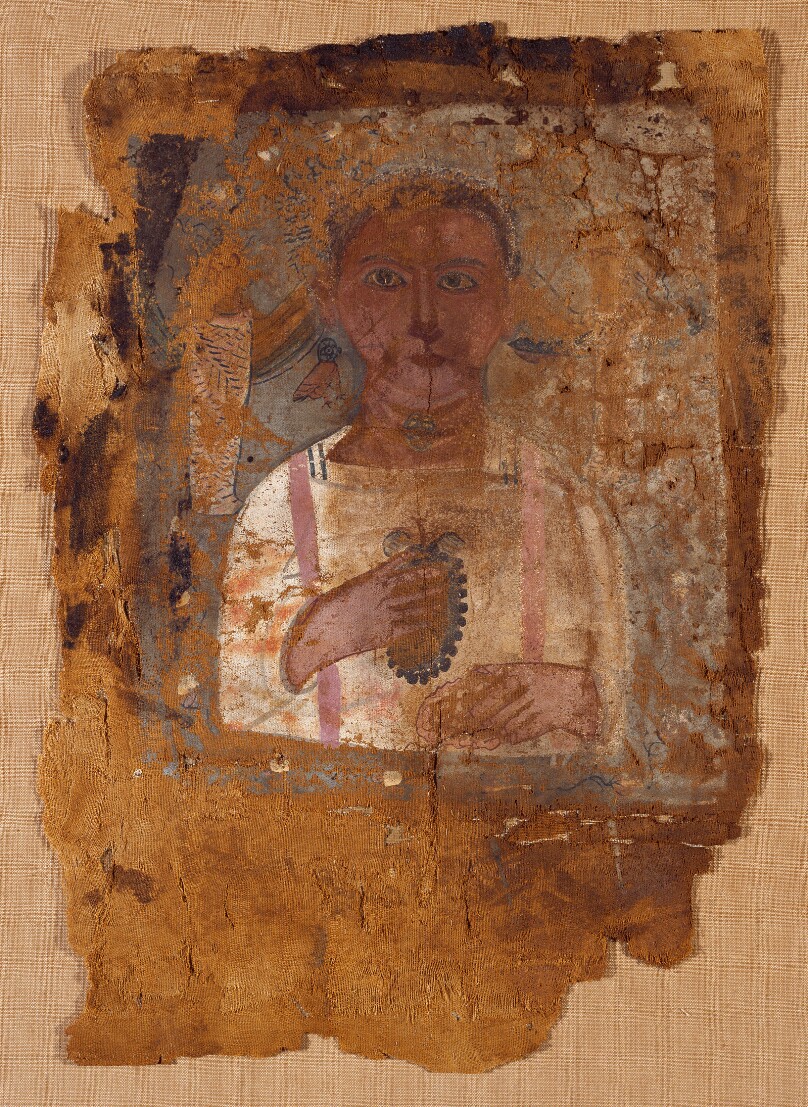
Mummy Shroud with Painted Portrait of a Youth
Creator
UnknownAll works by this person →More on Getty ULAN- Date
- A.D. 220–250
- Medium
- Tempera on linen
- Culture
- Romano-Egyptian
- Department
- Paintings
- Institution
- Getty Museum
- Object ID
- c6abc031-afcd-482b-b505-d04ff10bb449
From the Getty Museum record
Romano-Egyptian linen shroud with a half-length portrait of a deceased man holding a cluster of grapes (symbolic of fertility) in his right hand and a funerary garland of (probably) rose petals in his left. Shrouds of finely woven linen with portraits of the deceased provided an alternative to the use of wooden portrait panels, and they follow traditional funerary iconography equivalent to the panel portraits. Although many body length shrouds have survived (as Boston, Museum of Fine Arts [54.993](https://collections.mfa.org/objects/148455/funerary-shroud-of-tasheretwedjahor?ctx=b1508c51-765b-4ae9-ac8d-9c95460bdb4b&idx=4)), often, as in this case, the shroud was made to cover only the upper body of the mummy. Most surviving shrouds have been painted in tempera (pigment suspended in animal glue); though rare, encaustic (pigment suspended in wax) examples do survive. The man’s short Severan (AD 193-235) hairstyle is commensurate with Carbon-14 results providing a date range of AD 85-221. The overall style is simple, even provincial; the message of this portrait lies in its funerary attributes rather than on a sophisticated depiction of age or facial expression. He wears a short necklace with a round pendant in indigo (very damaged, with contours conforming to those of a protective Medusa head such as those that have survived). Surmounting his brow is a fragmentary suggestion of a wreath. He is clothed in a traditional white tunic as also seen on the wooden panel portraits, with a woven *clavus* (stripe) extending down from each shoulder. In this case the *clavi* have been painted with a pigment produced from pink madder to emulate the elite symbolism of purple. The gray background (achieved by painting tempera onto a white gypsum undercoat) was originally richly decorated with religious symbols associated with the cults of the dead. The presence of birds and winged deities is especially popular during the third century AD, where they appear on both shrouds and panels as companions or escorts. On either side of this man’s head are mummified winged figures likely representing Osiris; each extends an arm toward the deceased. A small bird in profile floats above the man’s proper right shoulder representing the presence of Horus, the falcon-god son of Isis and Osiris, or Harpokrates, the son of Isis and Serapis, both important religious protectors of human souls during their journey to the afterlife.
The authoritative record is held by Getty Museum. LinkedCulture surfaces this object and its connections; it does not alter institutional metadata.
Get printable QR codesHide QR codes
Open QR codes for this object page and the museum record. They stay collapsed until needed.
Related across collections
Semantically similar works from Getty Museum and other institutions.