Getty Museum
Studies of Women
Creator
Peter Paul RubensFlemish Artist · 1577–1640
All works by this person →International diplomat, savvy businessman, devout Catholic, fluent in six languages, an intellectual who counted Europe's finest scholars among his friends, Peter Paul Rubens was always first a painter. Few artists have been capable of transforming such a vast variety of influences into a style utterly new and original. After study with local Antwerp painters, Rubens began finding his style in Ita
More on Getty ULAN- Date
- 1628
- Medium
- Black, red, and white chalk, lower right corner replaced
- Culture
- Flemish
- Department
- Drawings
- Institution
- Getty Museum
- Object ID
- c7cde50e-409f-4d99-b1af-28cad69d58ec
From the Getty Museum record
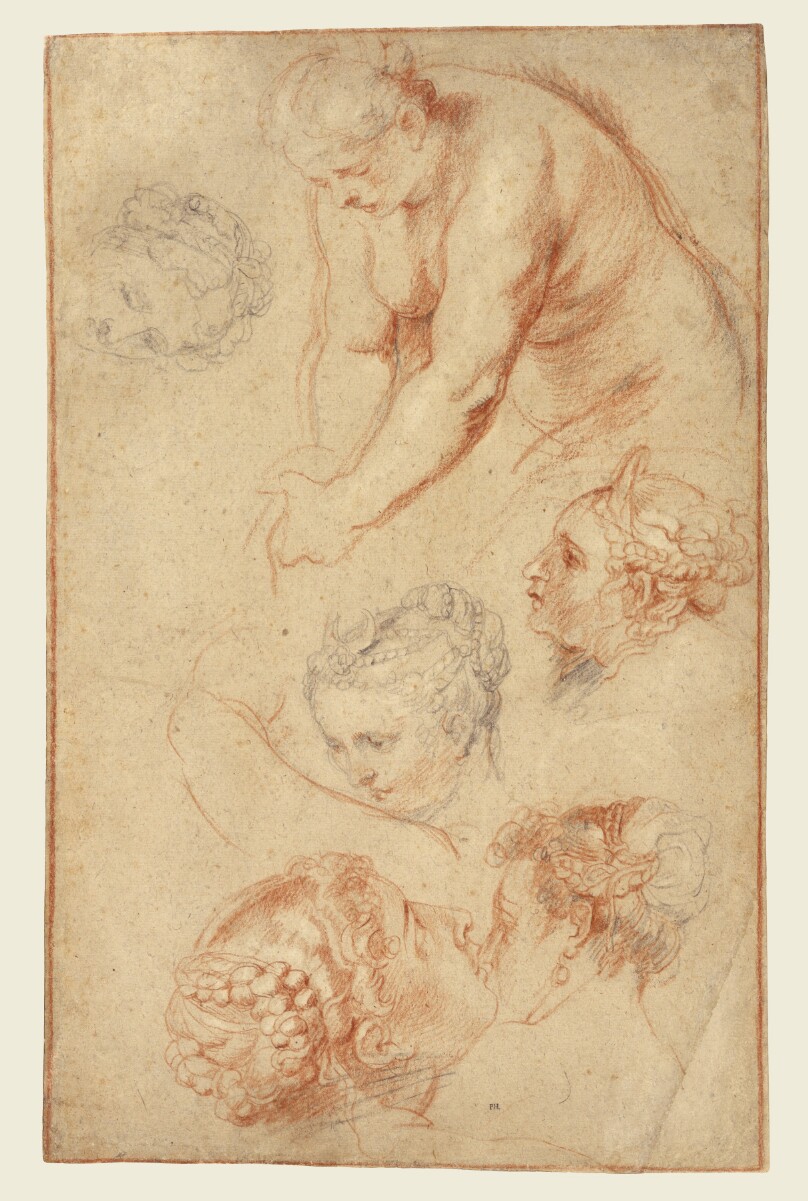
On a diplomatic mission to Spain in 1628, Peter Paul Rubens visited the royal palace in Madrid. Admiring three paintings by Titian that hung in adjacent rooms, he quickly sketched some of the profiles of various women he saw portrayed, intermingling motifs from the various works on a single sheet. Rubens focused on the angle and expression on each head, as well as the elaborately braided hairstyle and jewelry. By liberally layering in white chalk, the artist created a sensuous play of light over the hair. Smudgy black chalk strokes give volume to another woman's body and describe the muscular ripples on her arms. Rubens's chalk strokes ranged from the stronger, more powerful form of the nude body to the delicate strokes where the hair touches the back of one figure's neck. He very effectively used the combination of red, black, and white chalk, a technique known by the French term *aux troix crayons,* coined in the 1700s.
The authoritative record is held by Getty Museum. LinkedCulture surfaces this object and its connections; it does not alter institutional metadata.
Get printable QR codesHide QR codes
Open QR codes for this object page and the museum record. They stay collapsed until needed.
Related across collections
Semantically similar works from Getty Museum and other institutions.