Getty Museum
Irises
Creator
Vincent van GoghDutch Artist · 1853–1890
All works by this person →> I can very well do without God both in my life and in my paintings, but I cannot, ill as I am, do without something which is greater than I, which is my life--the power to create. > > --Vincent van Gogh Art was Van Gogh's means of personal, spiritual redemption, and his voluminous letters to his devoted brother Theo, one of which is quoted here, offer profound insight into the artistic struggle.
More on Getty ULAN- Date
- 1889
- Medium
- Oil on canvas
- Culture
- Dutch
- Department
- Paintings
- Institution
- Getty Museum
- Object ID
- c88b3df0-de91-4f5b-a9ef-7b2b9a6d8abb
From the Getty Museum record
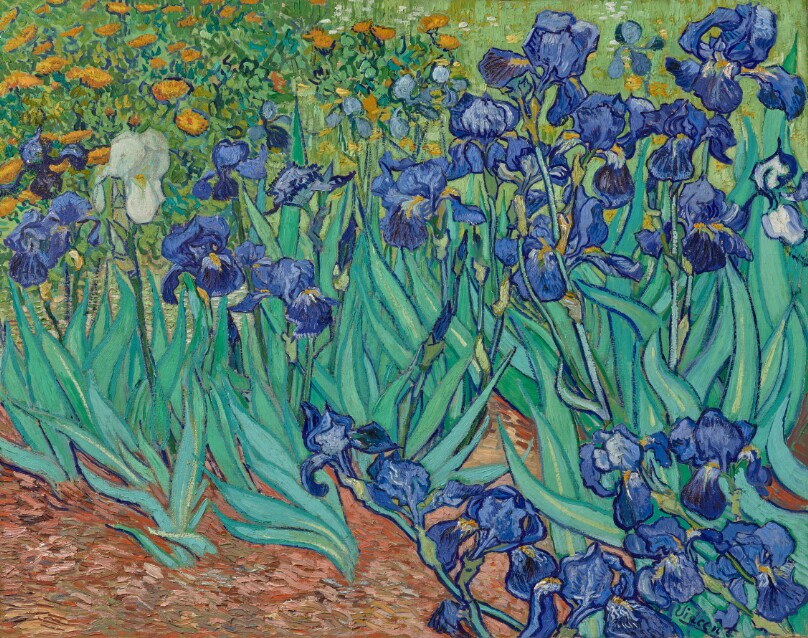
In May 1889, after episodes of self-mutilation and hospitalization, Vincent van Gogh chose to enter an asylum in Saint-Rémy, France. There, in the last year before his death, he created almost 130 paintings. Within the first week, he began *Irises*, working from nature in the asylum's garden. The cropped composition, divided into broad areas of vivid color with monumental irises overflowing its borders, was probably influenced by the decorative patterning of Japanese woodblock prints. There are no known drawings for this painting; Van Gogh himself considered it a study. His brother Theo quickly recognized its quality and submitted it to the *Salon des Indépendants* in September 1889, writing Vincent of the exhibition: "[It] strikes the eye from afar. It is a beautiful study full of air and life." Each one of Van Gogh's irises is unique. He carefully studied their movements and shapes to create a variety of curved silhouettes bounded by wavy, twisting, and curling lines. The painting's first owner, French art critic Octave Mirbeau, one of Van Gogh's earliest supporters, wrote: "How well he has understood the exquisite nature of flowers!"
The authoritative record is held by Getty Museum. LinkedCulture surfaces this object and its connections; it does not alter institutional metadata.
Get printable QR codesHide QR codes
Open QR codes for this object page and the museum record. They stay collapsed until needed.
Related across collections
Semantically similar works from Getty Museum and other institutions.