Getty Museum
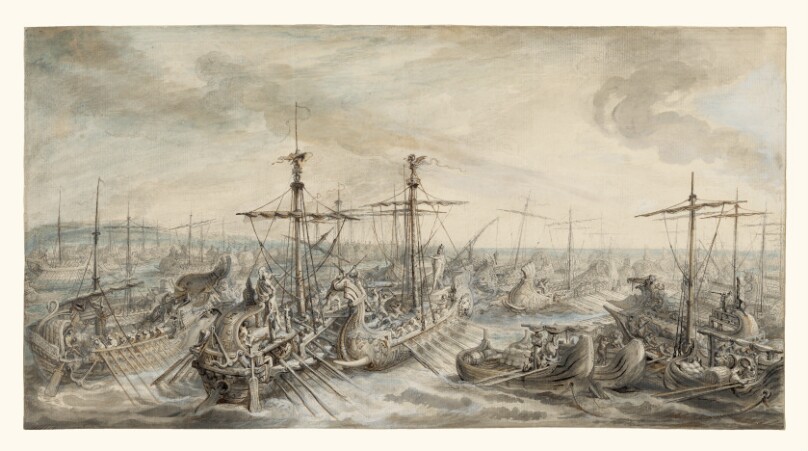
The Roman Fleet Victorious over the Carthaginians at the Battle of Cape Ecnomus
Creator
Gabriel Jacques de Saint-AubinFrench Artist · 1724–1780
All works by this person →Gabriel Jacques de Saint-Aubin died almost destitute, and he was little known in his time. His passion was chronicling daily Parisian life. He earned his meager living as an engraver and made gouaches and pastels, but he never stopped trying for a painting career. Saint-Aubin studied with a genre painter and then with François Boucher, whose facility and ease of style influenced his work. After th
More on Getty ULAN- Date
- about 1763
- Medium
- Watercolor, gouache, pen and India and brown ink over black chalk
- Culture
- French
- Department
- Drawings
- Institution
- Getty Museum
- Object ID
- c9f28102-a453-4402-97e2-43f4c2fb8ca3
From the Getty Museum record
The sea teems with a seemingly endless fleet of warships; a vast battle looms, ships crowd closer and closer to one another. Rows of oars froth up the sea, the frenzied water foreshadowing the impending combat. Standing at opposite ends of the two central ships are the leaders of warring factions. On one deck is the stoic Roman general Regulus, commanding his followers as they attempt to board an enemy ship. Opposing Regulus is the Carthaginian leader Hamilcar Barca, father of the famed general Hannibal. In fanciful reference to Hannibal, the Carthaginian prows are elephant heads armed with imposing ramming tusks. Gabriel Jacques de Saint-Aubin meticulously described every detail of the foreground ships. He first drew the composition in black chalk and then used pen and ink to further articulate details of the ships, such as their masts and riggings, and the myriad figures. Using a limited palette of deftly applied watercolor--gray, brown, and blue--Saint-Aubin sensitively colored the sea and sky. The first Punic War (264-241 BC) was a conflict largely fought at sea. Involving over three hundred vessels, the battle depicted here was one of the largest navel battles in history. The smaller Roman fleet defeated the Carthaginian by dividing their forces into four squadrons and waging four separate battles. This drawing is one of a series of illustrations Saint-Aubin made in the 1760s for an ambitious history of Rome. Engravings after drawings as well as maps were to accompany this multi-volume series which was never completed. In 1789, twenty-nine engraved plates from Saint-Aubin's drawings illustrated a more modest Roman history.
The authoritative record is held by Getty Museum. LinkedCulture surfaces this object and its connections; it does not alter institutional metadata.
Get printable QR codesHide QR codes
Open QR codes for this object page and the museum record. They stay collapsed until needed.
Related across collections
Semantically similar works from Getty Museum and other institutions.