Getty Museum
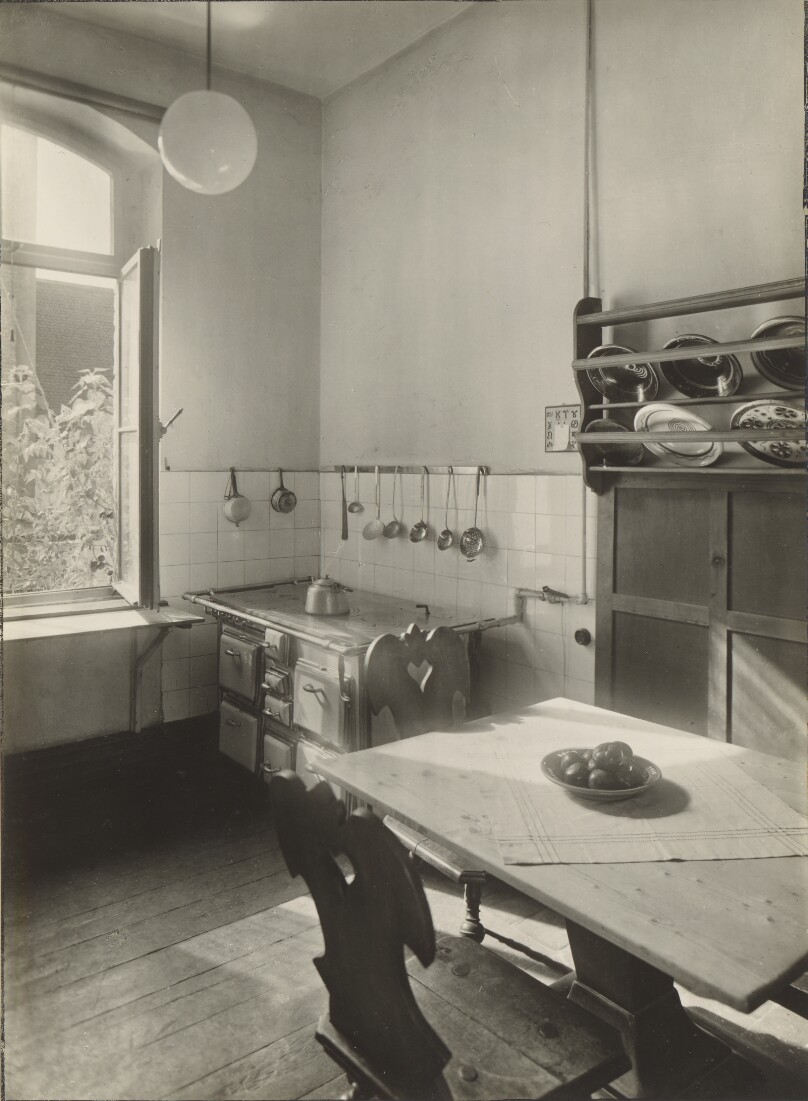
Sander's studio/home, Cologne: Kitchen (corner of hearth) (Sander's Studio/Wohnung, Köln: Küche (Herdecke))
Creator
August SanderGerman Photographer · 1876–1964
All works by this person →During military service, August Sander was an assistant in a photographic studio in Trier; he then spent the following two years working in various studios elsewhere. By 1904 he had opened his own studio in Linz, Austria, where he met with success. He moved to a suburb of Cologne in 1909 and soon began to photograph the rural farmers nearby. Around three years later Sander abandoned his urban stud
More on Getty ULAN- Date
- about 1930–1942
- Medium
- Gelatin silver print
- Culture
- German
- Department
- Photographs
- Institution
- Getty Museum
- Object ID
- cbf9acd7-5694-462a-95e2-cbded2b34683
From the Getty Museum record
> On September 1, 1939, World War II broke out. August Sander and his wife, Anna (1878-1957), gradually moved their belongings to the safety of Kuchhausen, a small village in the Westerwald, to avoid food rationing and the threat of Allied bombs. In 1944 their son Erich (1903-1944) fell ill in prison and died shortly thereafter of “unknown causes.” During the same year, their Cologne apartment was completely destroyed in an air raid. Sander's forty thousand negatives survived the war, having been stored in the Cologne basement (see [84.XM.152.222](https://www.getty.edu/art/collection/objects/35957/august-sander-sander's-studiohome-cologne-archive-in-the-air-raid-shelter-sander's-studiowohnung-koln-archiv-im-luftschutzkeller-german-about-1943/) and [84.XM.152.223](https://www.getty.edu/art/collection/objects/35958/august-sander-sander's-studiohome-cologne-air-raid-shelter-sander's-studio-wohnung-koln-luftschutzkeller-german-about-1943/)), however all but ten thousand of them were subsequently lost in a fire. > > Before the move to Kuchhausen, Sander created an album of photographs documenting his household and studio in Cologne-Lindenthal (see all sixty-four images: [84.XM.152.160 - 84.XM.152.223](https://www.getty.edu/art/collection/search/?pg=1&view=list&query=YTozOntzOjU6InF1ZXJ5IjtzOjExOiJzdHVkaW8vaG9tZSI7czo4OiJtYWtlci5pZCI7YToxOntpOjA7aToxNzUwO31zOjQ6InNvcnQiO3M6NjoiLXNjb3JlIjt9)). Just as he methodically recorded ways of life he feared would soon be lost in his portraits, Sander carefully mapped the exterior and interior of his home, room after room, preserving what he feared to be on the brink of destruction. > > Far from being a simple inventory of possessions, these photographs can be seen as a page in Sander's emotional autobiography. They trace his story from the mines near Herdorf to the sophisticated avant-garde circles of Cologne. Oscillating as they do between tradition, and innovation, the photographs acknowledge his work life, his daily life, his artistic ties, and his intellectual debts. They celebrate his family, his friendships, and even his cat. They are documents of melancholic introspection and commemoration, a physiognomy of the self, created at a time of great danger and uncertainty. > > Adapted from *August Sander*, In Focus: Photographs from the J. Paul Getty Museum by Claudia Bohn-Spector (Los Angeles: J. Paul Getty Museum, 2000), 98. ©2000, J. Paul Getty Trust.
The authoritative record is held by Getty Museum. LinkedCulture surfaces this object and its connections; it does not alter institutional metadata.
Get printable QR codesHide QR codes
Open QR codes for this object page and the museum record. They stay collapsed until needed.
Related across collections
Semantically similar works from Getty Museum and other institutions.