Getty Museum
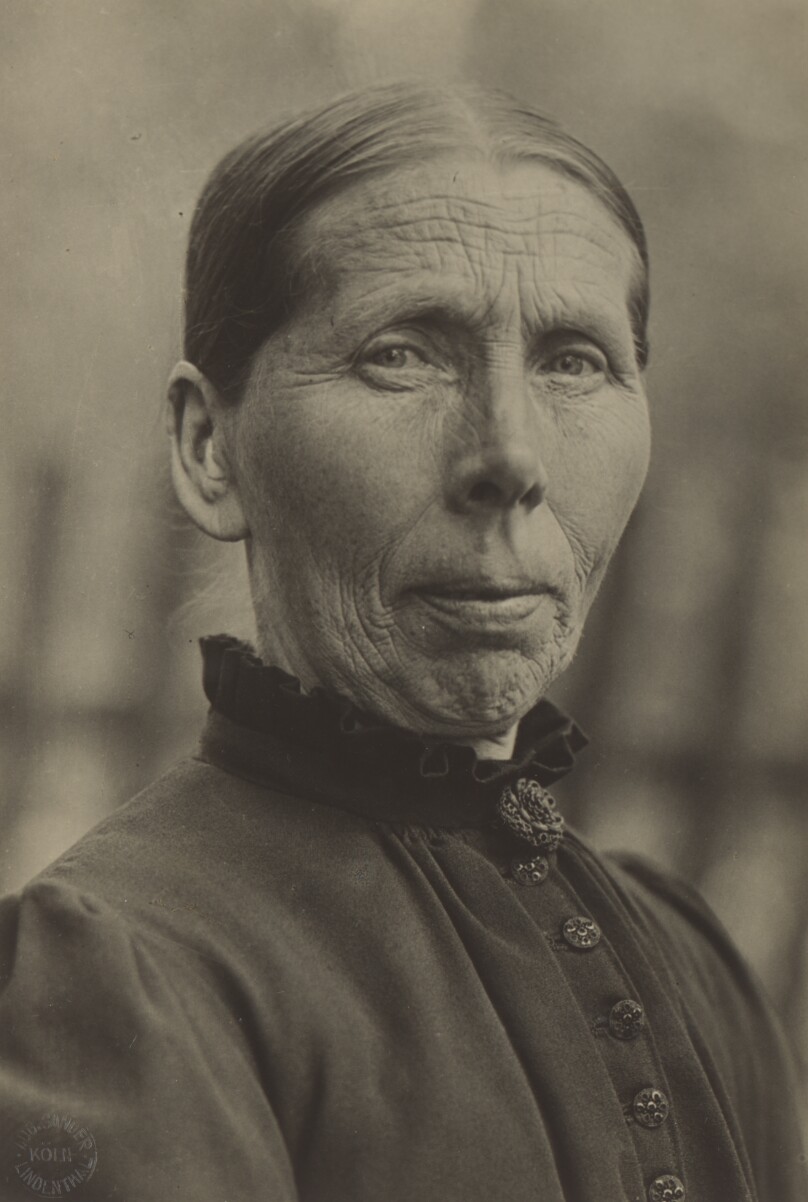
Peasant Woman, Westerwald
Creator
August SanderGerman Photographer · 1876–1964
All works by this person →During military service, August Sander was an assistant in a photographic studio in Trier; he then spent the following two years working in various studios elsewhere. By 1904 he had opened his own studio in Linz, Austria, where he met with success. He moved to a suburb of Cologne in 1909 and soon began to photograph the rural farmers nearby. Around three years later Sander abandoned his urban stud
More on Getty ULAN- Date
- negative 1913; print about 1930
- Medium
- Gelatin silver print
- Culture
- German
- Department
- Photographs
- Institution
- Getty Museum
- Object ID
- ccf0ec57-a602-47df-ae17-9dc356b0920b
From the Getty Museum record
> Throughout the 1930s August Sander was busy assembling the material for “Citizens of the Twentieth Century.” This ambitious project was to be a physiognomic portrait of the German people, a comprehensive cultural history and social analysis in pictures. In the Portfolio of Archetypes he established an inventory of core features—a physiognomic “baseline”—against which all other social classes and professions would be measured. Physiognomy, the study of systematic correspondence between a person’s facial features or body structure and his/her psychological character, gained in popularity in the nineteenth century and has served as disturbing justification for racial profiling, discrimination and genocide in the twentieth and twenty-first centuries. Sander began sorting through his archives of old negatives, going as far back as the early teens, reprinting many of his commissioned portraits for incorporation into his system. Among them was this photograph of a peasant woman. > > As he worked, Sander extracted tightly cropped head shots from full-length portraits, creating a standardized format to facilitate the contemplation of the different human types on display. In look and function, these images are reminiscent of ethnological photographs executed by the hundreds of thousands in the late nineteenth century. However, instead of documenting the peoples from faraway places, Sander's pictures trace the different physiognomies and “tribes” of his native Germany. As the physician and writer Alfred Doblin (1878-1957) noted in his introduction to the preview of sixty images of Sander’s grander project published in 1929 and titled *Face of the Time*, the pictures' scientific stance invites comparison: “Just as there is a comparative anatomy which enables one to understand the nature and history of organs, so here the photographer has produced a comparative photography, thereby gaining a scientific standpoint which places him beyond the photographer of detail.” Similarly, the writer and critic Walter Benjamin (1892-1940) observed in his 1931 essay “A Short History of Photography”: “Sander's work is more than a book of pictures. It is a training manual.” > > Adapted from *August Sander*, In Focus: Photographs from the J. Paul Getty Museum by Claudia Bohn-Spector (Los Angeles: J. Paul Getty Museum, 2000), 36. ©2000, J. Paul Getty Trust.
The authoritative record is held by Getty Museum. LinkedCulture surfaces this object and its connections; it does not alter institutional metadata.
Get printable QR codesHide QR codes
Open QR codes for this object page and the museum record. They stay collapsed until needed.
Related across collections
Semantically similar works from Getty Museum and other institutions.