Getty Museum
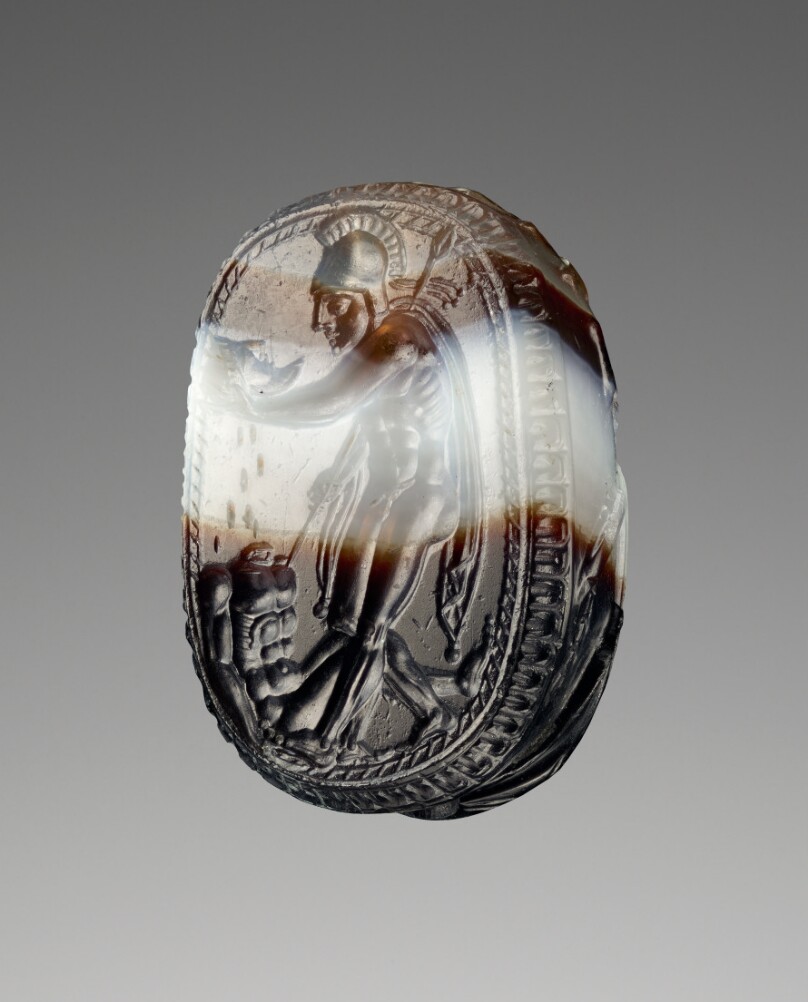
Engraved Scarab with a Warrior Holding a Head
Creator
UnknownAll works by this person →More on Getty ULAN- Date
- 400–375 B.C.
- Medium
- Banded brown and white agate
- Culture
- Etruscan
- Department
- Jewelry
- Institution
- Getty Museum
- Object ID
- ce0c4d07-ce6c-458a-b9c2-f8e02b7c4dbb
From the Getty Museum record
A helmeted warrior carrying a spear with his cloak thrown over his shoulder holds up a severed head, still dripping blood. The decapitated body of his enemy lies at his feet. The scene was probably drawn from the Greek myth of the Seven against Thebes. In the battle for the city, Tydeus killed Melanippos, one of the Theban defenders, but was himself mortally wounded. As he lay dying, he asked Amphiaraos to bring him the head of his opponent. Although described in Greek myth, the mutilation of the dead enemy rarely appears in Greek art--except for Achilles dragging the body of Hektor, where it is a sign of his madness. The Etruscans, however, commonly depicted such scenes. Scarabs were introduced to Etruria in the later 500s B.C., first through Greek imports and then through emigrant Greek artists. In this period many Ionian artists, including gem carvers, fled Persian aggression in their homeland. Some went to Etruria, which was a stable and wealthy region. In Etruria the jewelry aspect of the scarab was emphasized: the beetle sits on a decorated plinth, and its anatomy is carved in detail, usually with incised winglets and stippled heads. The scarab form remained popular into the late 400s and 300s B.C. in Etruria, long after it had gone out of style in Greece.
The authoritative record is held by Getty Museum. LinkedCulture surfaces this object and its connections; it does not alter institutional metadata.
Get printable QR codesHide QR codes
Open QR codes for this object page and the museum record. They stay collapsed until needed.
Related across collections
Semantically similar works from Getty Museum and other institutions.